📖 Story
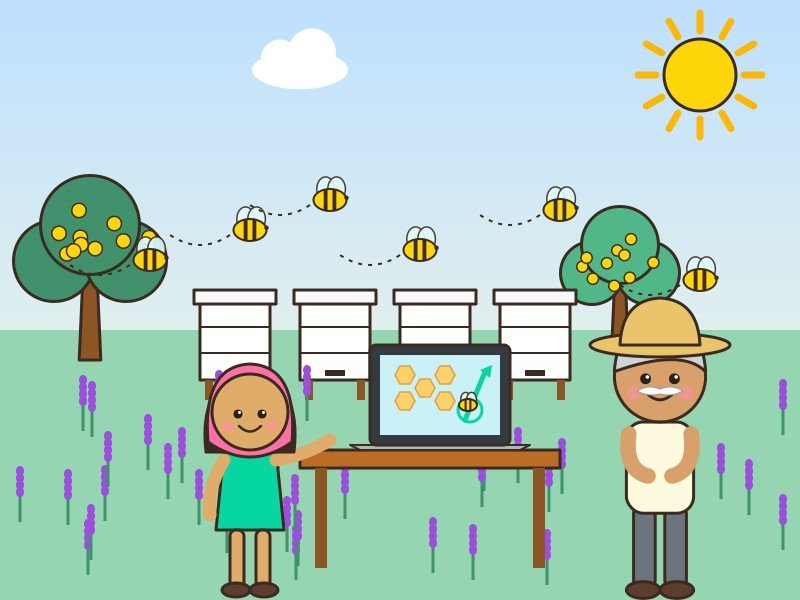
Tasneem was twelve years old, and her room looked more like a small laboratory than a bedroom. On her desk were colored wires, small circuit boards, lamps, and books about robots, insects and space. She dreamed of becoming an inventor who solved real problems. Every weekend she visited her grandfather, Abu Hassan, a beekeeper who kept ten white wooden beehives in the garden of his house, among lemon trees and beds of lavender. Her grandfather used to tell her, "Bees, Tasneem, are cleverer than people think. They talk, but we don't understand their language."
On one visit, Tasneem noticed that her grandfather was sad. He was standing in front of an open hive, lifting a wooden frame covered with honeycomb and looking at it with worry. "Look, Tasneem," he said. "There's very little honey this season. The bees come back exhausted, and some of them never come back at all. I don't know what has changed." Tasneem asked, "And how can we know where the bees go?" Her grandfather said, "Scientists discovered that when a bee finds plenty of flowers, she comes back to the hive and does a special dance to tell her sisters where the flowers are. It's called the waggle dance. But I can't read it with my own eyes."
An idea flashed in Tasneem's head, as if a lamp had switched on inside it. She spent that whole night reading about the bee dance. She learned that the bee walks across the honeycomb in a straight line while waggling her body, then turns and comes back, tracing a shape like the number eight. She learned that the direction of the straight line shows the direction of the flowers in relation to the sun: if the bee dances straight up, the flowers are in the direction of the sun. And she learned that the length of the waggle shows the distance: the longer the dance, the farther away the flowers. Tasneem said to herself, "This is a language! And it has rules! And every language with rules can be translated."
Over the following weeks, Tasneem worked on her invention. She used a small camera like the ones in phones and placed it behind a glass panel in a special observation hive her grandfather had built, so she could see the bees without disturbing them. Then she wrote a program on her old computer that followed the movements of the dancing bees and measured the angle of the straight line and the length of the waggle. At first the program made lots of mistakes. It thought every walking bee was dancing, or it mixed up two bees. Tasneem fixed it again and again and wrote her observations in a notebook she called The Notebook of Beautiful Mistakes.
One day her little brother laughed and said, "Tasneem wants to talk to the bees! Are you going to ask them how they're doing?" Tasneem didn't get angry. She said, "Maybe. Why not? Isn't it wonderful to understand those who live with us on this earth?" She sat for long hours in front of the screen, watching the bees until her back ached. Her grandfather would bring her a cup of mint tea, sit beside her and say, "A real scientist is patient like a bee, gathering knowledge drop by drop."
After a month of work, the big day came. Tasneem switched on the device, pointed the camera at the hive and waited. A tired bee came in, stood on the comb and began to dance: walking straight while waggling, then turning, then coming back. On the screen a green circle appeared around the bee, then an arrow pointing in a direction, and then the words Tasneem had programmed to translate the dance: Many flowers, southwest, distance about four kilometers. Tasneem shouted, "It worked! It worked, Grandpa! The device is translating!"
But her grandfather's joy soon turned to worry. "Four kilometers?" he said. "That's very far for a bee! In the past my bees found flowers only a few hundred meters away." Tasneem kept watching and saw that most of the dances pointed to faraway places. Then she opened a map of the neighborhood on her computer and drew circles around the hives according to the distances. Little by little she understood. The big field near the neighborhood that used to be full of wildflowers had become a car park. And most of the front gardens of the houses had become tiles or artificial grass where not a single flower grew.
Tasneem said, "Grandpa, the bees aren't sick and they aren't lost. They're hungry! They fly very long distances to find food, so they get exhausted, and some can't make it back. That's why there's so little honey." Her grandfather looked at the map for a long time, then said, "I saw with my own eyes the field disappearing and the gardens changing, but I never connected the two. Your device has made us see what we couldn't see." Then he asked, "But what can we do? We can't bring the field back." Tasneem thought and said, "We can't bring the field back, but we can make lots of little fields."
The next day Tasneem made a colorful poster with a picture of a smiling bee, the map of the neighborhood and the arrow pointing to the faraway distance, and she wrote on it: Our neighborhood's bees are hungry. Will you plant a flower for them? She hung it in the grocery shop, at school, on the mosque door and by the public park. Then she asked the school principal to let her present her invention at morning assembly. Tasneem stood in front of the students, her hands trembling a little, and showed the bee's dance and its translation on the big screen, and she heard the students say in amazement, "Wow!"
The change began slowly, and then it grew. The schoolchildren planted beds of lavender, sunflowers and thyme in the schoolyard. Their neighbor, Umm Rami, removed some of the tiles from her garden and planted rosemary in their place. The grocer brought old wooden crates, and the children turned them into flower boxes along the pavements. Tasneem persuaded her father to talk to the municipality, and it agreed to plant a strip of wildflowers along the edge of the big car park. In spring the neighborhood was more colorful than it had been for years.
Two months later, Tasneem and her grandfather sat in front of the screen again. A lively bee came in and danced a short, quick dance, and the translation appeared: Many flowers, north, distance about three hundred meters. Then another bee: Flowers, east, distance two hundred meters. Tasneem looked at the map and saw that one arrow pointed straight at the schoolyard and the other at Umm Rami's garden. Her grandfather gave a loud laugh she had not heard from him in a long time and said, "The bees have found their food close to home!" By the end of summer the hives were full of golden honey that tasted of lavender and thyme.
At the national science fair, Tasneem's invention won first prize. When one of the judges asked her, "What is the most important thing you learned from your project?" she thought for a moment and said, "I learned that the device alone wasn't enough. The device translated the bees' dance, but it was people who planted the flowers. Technology is at its best when it helps us understand nature and take care of it, not when it makes us forget it. And I also learned that the many mistakes in my notebook were the road to success." Everyone applauded, and her grandfather, in the front row, wiped away a tear of joy.
Tasneem went back to her grandfather's garden and sat among the white hives, listening to the calm hum of the bees returning loaded with pollen. She knew that every flower someone in the neighborhood had planted was a word in a long letter to the bees, saying: We hear you. Tasneem learned that real science begins with patient listening to the world around us, that a great invention is one that solves a real problem, and that one sincere idea can bring a whole neighborhood together in a beautiful task.

💬 Comments (0)
Add a comment
No comments yet. Be the first to comment.