A story
Old Hakim and the Three Bridges
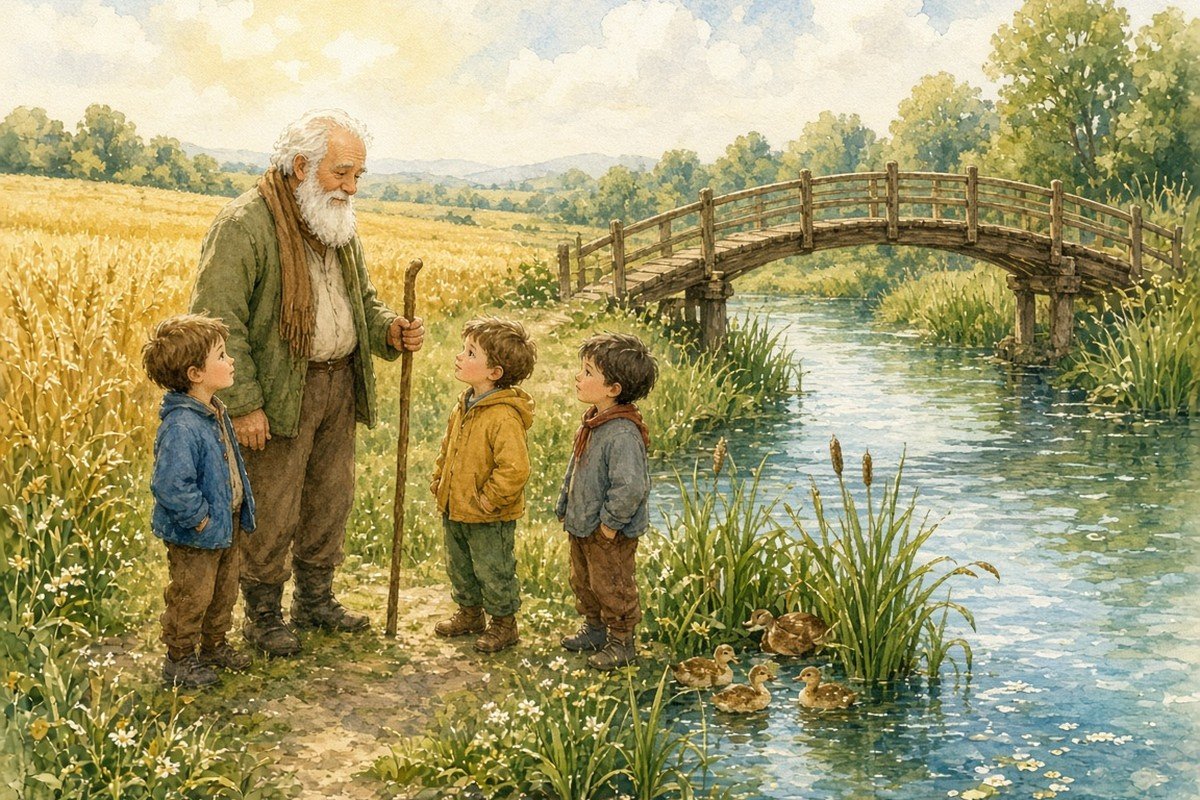
In a village between two rivers, there lived an old man named Hakim. His beard was white as cotton, and his eyes were kind and bright. Hakim was not rich, and he was not a prince. But everyone in the village came to him when they had a problem, because Hakim was very wise.
One spring morning, three young brothers came running to his door. Their names were Fadi, Samir, and little Karim, who was the youngest.
"Grandfather Hakim!" cried Fadi. "Our father has gone to the city across the river to sell his dates. He told us to bring him the big basket of figs that he forgot. But the old bridge has been washed away by the spring flood!"
"There are three new bridges now," said Samir, "built by the villagers last week. But we do not know which one is best."
Hakim stroked his white beard. "Then let us walk together and look at them," he said.
They walked along the riverbank until they came to the first bridge. It was made of shiny new planks, painted bright red. It looked very fine.
"This one!" said Fadi at once. "It is the most beautiful. Let us cross quickly!"
"Wait," said Hakim gently. "A bridge is not for looking at. A bridge is for walking on. Let us see how it is made."
He knelt down and looked underneath. The red planks were tied together with thin string, and the poles beneath them were short and did not reach the riverbed. The bridge only looked strong.
"Oh," said Fadi, and his face grew red like the paint.
They walked on to the second bridge. This one was very long, and it went the slow way around, past a bend in the river, past a field of barley, and over a little island.
"This will take all morning," groaned Samir. "Let us find something faster."
"Perhaps," said Hakim. "But let us look first."
He knelt again and looked underneath. The poles were thick and deep. The ropes were strong and new. Every plank was nailed tight.
"It is long," said Hakim, "but it is safe."
Then they came to the third bridge. It was not a bridge at all, really. It was a single tree trunk that someone had pushed across the narrowest part of the river. It was very short. One could cross it in ten steps.
"This is the fastest!" said Samir, already putting his foot on it. "Ten steps and we are there!"
"Wait," said Hakim again.
Samir stopped. Hakim picked up a small stone and tossed it gently onto the middle of the log. The log rolled a little to one side. Then it rolled to the other. It was wet and slippery with river moss.
"With a heavy basket of figs in your arms," Hakim said softly, "would you like to cross a log that rolls?"
Samir took his foot back quickly. "No," he said. "I would not."
Now all three boys looked at the long, slow bridge. Little Karim, who had said nothing all morning, spoke at last.
"Grandfather Hakim, why did the people build a pretty bridge that is not strong, and a short bridge that is not safe?"
Hakim smiled. "Because some people are in a hurry to be admired, and some people are in a hurry to arrive. But the people who are patient take the time to build things that last."
So the four of them went back to fetch the big basket of figs. It was very heavy. Fadi and Samir carried it between them, and little Karim carried the water jug. Hakim walked with his stick.
They crossed the long bridge. They walked past the bend in the river. They walked past the field of barley, where the farmers waved to them. They crossed over the little island, where ducks were sleeping in the reeds. Karim stopped to watch a family of baby ducks paddle after their mother.
"If we had taken the log," he said, "we would never have seen them."
The sun climbed higher. The boys grew hot and a little tired. Samir began to grumble again. "We are so slow," he said.
"Slow is not the same as late," said Hakim. "Slow and sure arrives. Fast and careless falls."
At last, at noon, they reached the city on the other side. Their father was standing in the market under a striped awning, looking worried.
"My sons!" he cried. "I was afraid you would try the log bridge! A man fell into the river from it this very morning, with all his oranges. The oranges are still floating down to the sea!"
The boys looked at one another and then at Hakim.
"And the red bridge?" asked Fadi.
"Ah," said their father. "Half of it fell down an hour ago, when a goat walked across."
Everyone laughed, even Fadi, though his cheeks turned pink again.
Their father sold the figs for a good price, and he bought sweet sesame cakes for all of them. They sat in the shade and ate them slowly, with crumbs on their chins.
On the way home, Samir walked beside Hakim. "Grandfather," he said, "next time I want to do something fast, I will think of the log that rolls."
"And next time I want something just because it is pretty," said Fadi, "I will look underneath it first."
Little Karim said, "And I will remember the baby ducks."
Hakim laughed his deep, warm laugh. "Then today, my children, you have crossed three bridges, and learned three lessons. That is a very good day indeed."
When they returned to the village, the boys told everyone what they had seen. The next week, the villagers worked together to make the long bridge a little shorter, by building a new path straight across the island, strong and patient and true. They took their time. They checked every rope and every plank.
And when it was finished, they asked Hakim to be the first to walk across it. He walked slowly, with his stick tapping on the planks, and all the children of the village walked behind him, laughing and singing.
The lesson: Patience and care lead us safely to where we want to go, while hurry and showing off can make us fall.