A story
Zaid and the Village Well
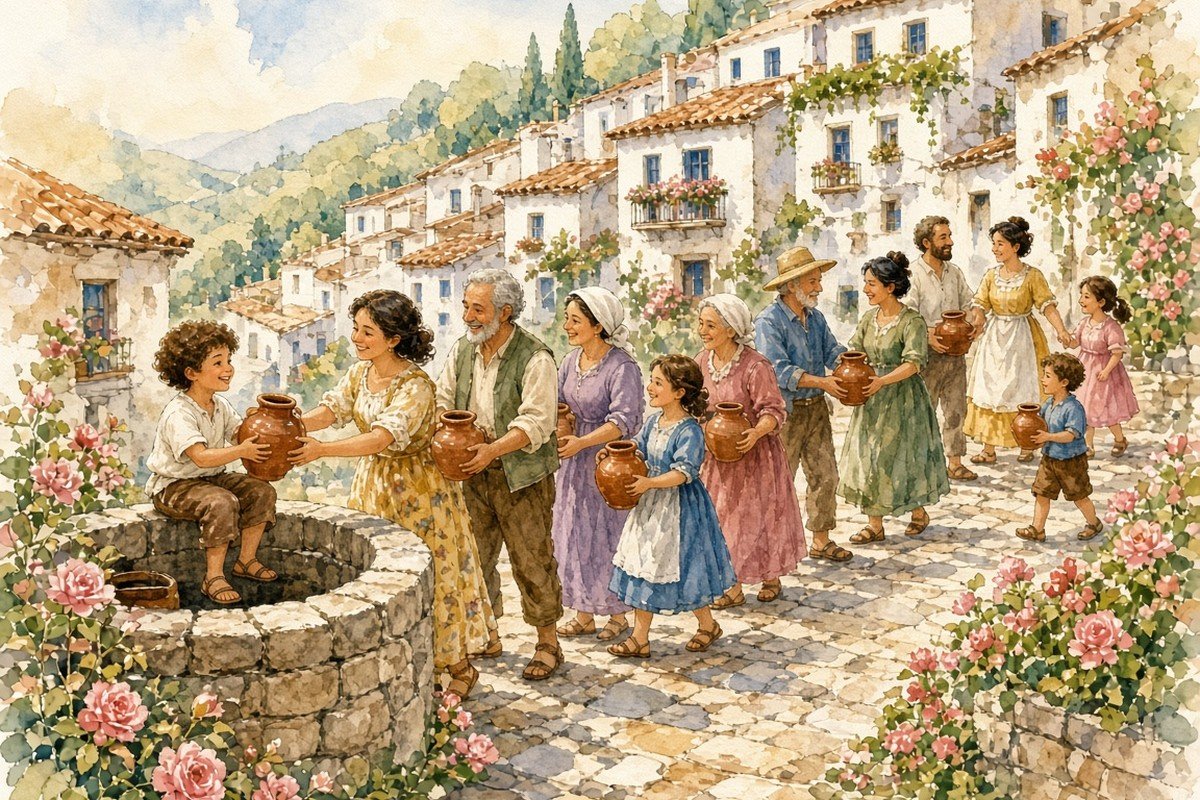
High in the hills, there was a village called Ain al-Ward, which means "the Spring of Roses." It had little white houses, narrow lanes full of cats, and gardens full of roses. And right in the middle of the village square, there was a deep stone well.
Every family in Ain al-Ward drew water from the well. But there was a problem. The well had only one bucket and one long rope, and every morning, all the families wanted water at the same time.
"Me first!" shouted the baker. "I need water for my bread!"
"No, me first!" shouted the blacksmith. "My fire is hot, and I need to cool my iron!"
"My goats are thirsty!" cried the goat herder.
"My flowers are wilting!" cried the gardener.
Every morning, they pushed and pulled and argued. Sometimes they tugged the rope so hard that the bucket banged against the stones and spilled half the water back into the well. Sometimes nobody got any water at all until noon. And every morning, the people of Ain al-Ward went home grumpy and thirsty.
In the village lived a boy named Zaid. He was nine years old, small for his age, with curly hair and a curious mind. Zaid liked to sit on the wall of the square and watch. And the more he watched, the more he thought.
One morning, after an especially loud argument, the village elder, a tall old man named Sheikh Mansour, banged his stick on the ground.
"Enough!" he said. "This cannot go on. Whoever can find a way to share the well fairly, so that every family has water by breakfast, will be honored at the Rose Festival this spring."
The grown-ups scratched their heads. The baker said, "Let us dig a second well!" But the ground was hard rock, and digging would take years. The blacksmith said, "Let us make a bigger bucket!" But a bigger bucket would be too heavy to pull up.
Zaid said nothing. He went home and thought and thought.
That night he could not sleep, so he went to the window. He saw his mother in the kitchen, passing plates to his big sister, who passed them to his little brother, who stacked them on the shelf. One, two, three. Plate after plate, smooth and quick. Nobody dropped anything. Nobody argued.
Zaid's eyes grew wide. "That's it!" he whispered.
The next morning he went to Sheikh Mansour. "Sheikh," he said, "may I try my idea tomorrow at dawn? I need every family to come, and each family must bring one jar."
The old man raised an eyebrow, but he nodded. "Very well, little Zaid. Let us see."
At dawn, every family came to the square, each with one jar. They looked sleepy and doubtful. The baker yawned. The blacksmith grumbled.
Zaid climbed up on the edge of the well so everyone could see him.
"Today," he said, "nobody pulls the bucket alone. Please stand in a line, from the well all the way down the lane, like a long necklace."
The villagers looked at each other, but they did as he asked. The line stretched from the well, past the bakery, past the blacksmith's shop, all the way to the last rose garden at the bottom of the lane.
"Now," said Zaid, "the two strongest people will pull up the bucket together." The blacksmith and the goat herder stepped forward, and they pulled the rope together. The bucket came up quickly and smoothly, full to the brim, without banging against the stones.
"Now pour it into the first jar," said Zaid, "and pass the jar down the line to whichever family is at the end."
The first jar went from hand to hand, all the way down the lane, to the gardener at the bottom. Meanwhile, the bucket went down again. Up it came, into the second jar, and down the line that jar went to the next family.
Splash, pass, pass, pass. Splash, pass, pass, pass. It was like music. Children giggled as the jars came to them. Old women hummed. Soon the baker started singing a working song, and everyone joined in.
Before the sun had even climbed over the hill, every jar in Ain al-Ward was full. Nobody had pushed. Nobody had argued. Not a single drop had been spilled.
The villagers stood in the square in surprise. "But how did that happen so fast?" asked the baker.
Zaid smiled shyly. "When everyone grabbed the rope at once, we all pulled against each other," he said. "But when we pulled together and passed things along, we all helped each other."
Sheikh Mansour laughed his big booming laugh. "The smallest boy in the village has taught the biggest lesson!" he said.
From that day on, the people of Ain al-Ward drew water the new way every morning. They even made it a little game. Each day, a different family stood at the end of the line, so that everyone had a turn to be first and a turn to be last.
And something else changed too. Because they stood together every morning, the neighbors began to talk. The baker learned that the blacksmith's wife was sick, and he brought her warm bread. The gardener learned that the goat herder's children loved flowers, and he gave them roses. The village that had been so grumpy became a village of friends.
When spring came, the Rose Festival was the happiest it had ever been. Sheikh Mansour placed a crown of pink roses on Zaid's curly head. And the whole village stood in a long line, from the well to the bottom of the lane, and passed something new from hand to hand: plates of sweet cakes, enough for everyone.
The lesson: When we work together instead of against each other, hard jobs become easy and neighbors become friends.