A story
The Queen's Riddle of the Empty Jar
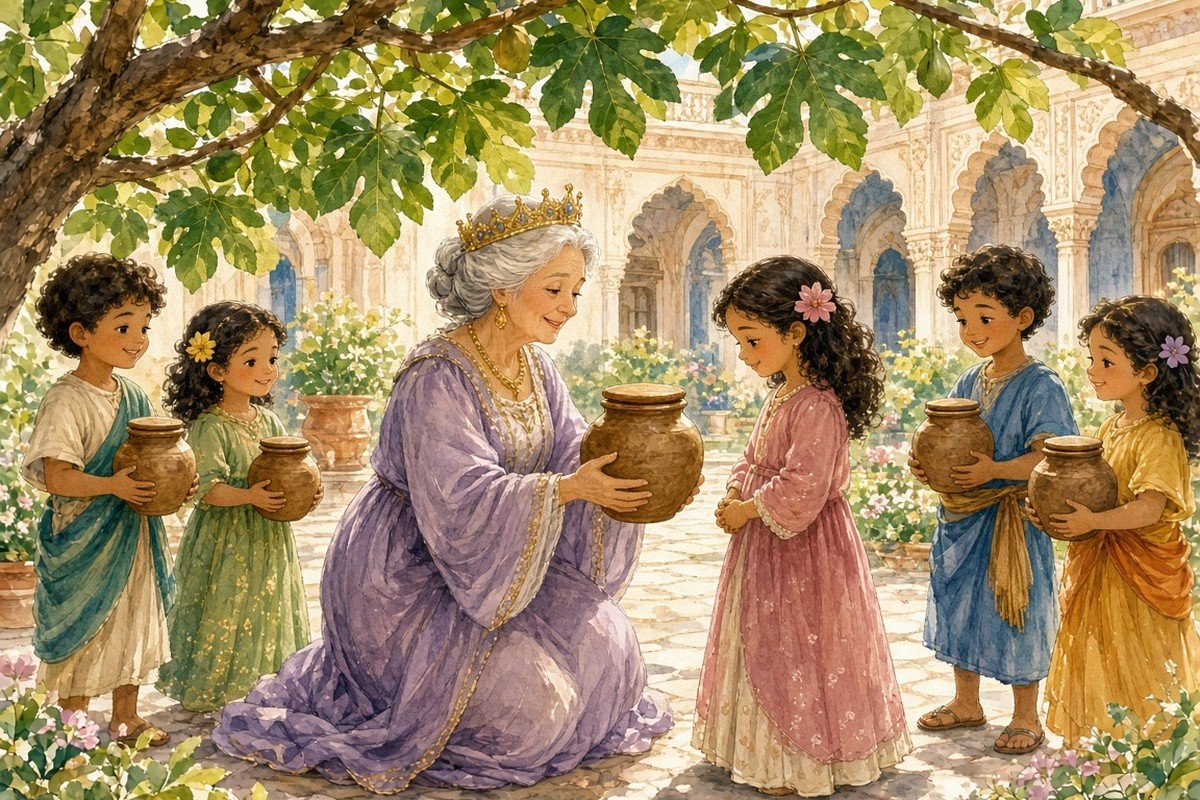
In the kingdom of Bustan, there ruled a wise and gentle queen named Queen Yasmin. She was growing old, and she had no children of her own. So one day she announced that she would choose a young helper to learn from her and, one day, to help rule the kingdom.
"I do not care if the helper is rich or poor," she said. "I do not care if they are a boy or a girl, or what village they come from. I only care that they are wise."
Children came from every corner of Bustan. There were children of merchants in silk clothes, children of farmers with dusty feet, children of soldiers with straight backs. They all gathered in the palace courtyard, under the great fig tree.
The queen stood before them. Beside her was a table, and on the table sat twenty clay jars, all exactly the same. Each one was round and brown and had a wooden lid.
"Each of you will take one jar home," said the queen. "In one month, bring it back to me filled with the most precious thing you can find. Whoever brings the most precious thing will be my helper."
The children were very excited. They each took a jar and hurried home.
Among them was a quiet girl named Huda. She lived with her grandfather in a small house at the edge of the kingdom, where the fields met the hills. Huda's family was poor. They had no gold, no jewels, and no silk. When she got home, she set the empty jar on the table and looked at it sadly.
"Grandfather," she said, "the merchant's son will fill his jar with gold. The jeweler's daughter will fill hers with pearls. What can I put in mine?"
Her grandfather smiled. "The queen did not say the most expensive thing," he said. "She said the most precious. Those are not always the same."
Huda thought about this for many days.
First, she went to the field and filled the jar with the best wheat. "Wheat is precious," she thought. "Without it, there is no bread." But then she saw a neighbor whose crop had failed, with hungry children. Huda gave the wheat to them. Her jar was empty again.
Next, she went to the spring and filled the jar with cool, clean water. "Water is precious," she thought. "Without it, nothing can live." But on the way home she met an old shepherd whose sheep were thirsty, far from any stream. Huda poured the water into his trough. Her jar was empty again.
Then she gathered sweet honey from her grandfather's beehives. "Honey is precious," she thought. But that very day, a little boy in the village fell sick with a sore throat, and the healer said that honey would help him. Huda brought him her jar of honey. Her jar was empty again.
At last, the month was over. Huda had nothing left. Her jar was as empty as the day she had first carried it home.
"I cannot go to the palace with an empty jar," she said, and her eyes filled with tears. "Everyone will laugh at me."
"Go anyway," said her grandfather gently. "Tell the queen the truth. The truth is never empty."
So Huda walked to the palace, carrying her empty jar.
In the courtyard, the other children were already lined up. One by one they opened their jars. The merchant's son had filled his with gold coins. The jeweler's daughter had filled hers with pearls. One boy had brought rare spices. One girl had brought perfume from faraway lands. The courtyard sparkled and smelled sweet.
Then it was Huda's turn. Her hands were shaking. She lifted the lid. The jar was empty.
Some of the children giggled. A few whispered. But Queen Yasmin raised her hand, and the courtyard fell silent.
"Tell me, child," she said kindly, "why is your jar empty?"
So Huda told her everything. About the wheat she had given to the hungry family. About the water she had poured for the thirsty sheep. About the honey she had taken to the sick little boy.
"I tried to fill it with precious things, Your Majesty," she said. "But every time, someone needed them more than I did."
The queen was quiet for a long moment. Then she came down the steps, and she knelt in front of Huda and took the empty jar in her hands.
"Children," she said, turning to the others, "look at this jar. It is empty. But do you know what it held? It held bread for hungry children. Water for thirsty animals. Medicine for a sick friend. It held kindness, three times over. And kindness does not stay in a jar. It goes out into the world."
She held the jar up high. "Gold can be counted. Pearls can be lost. But a heart that gives what it has to those who need it is the most precious thing in any kingdom."
Then the queen turned to Huda and smiled. "Will you be my helper, Huda?"
Huda could not speak. She only nodded, with happy tears on her cheeks.
From that day, Huda lived and learned at the palace, though she visited her grandfather every week. When she grew up, she became the queen's most trusted advisor. And in the throne room, on a special shelf where everyone could see it, there sat a plain brown clay jar with a wooden lid.
It was always empty. And it was always the most precious thing in the room.
The lesson: The most precious thing we can give is kindness to those in need.