A story
Ziba the Zebra Foal Who Wished for Spots
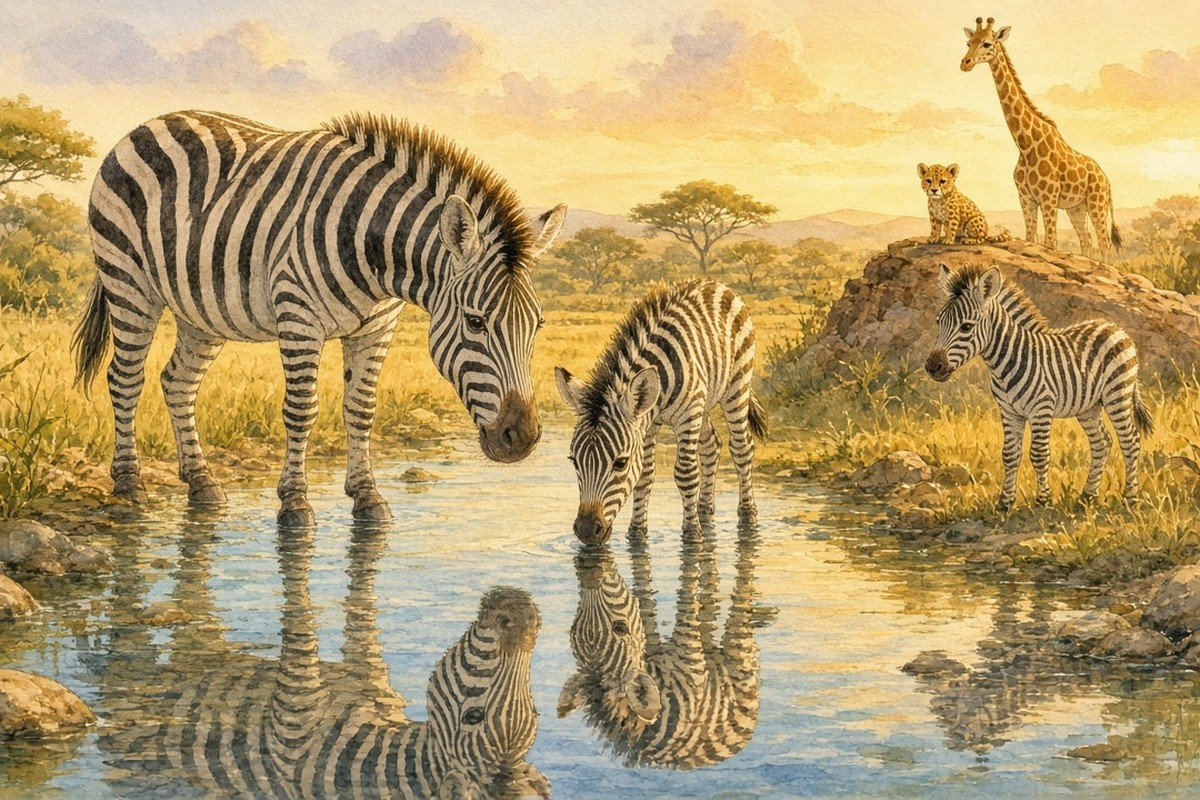
On a wide, grassy plain, where the sky was huge and the sun was warm, there lived a little zebra foal named Ziba. She had long legs, a short, bristly mane that stood straight up like a brush, and a coat of black and white stripes from her nose to the tip of her tail.
Ziba lived with her mother in a big herd of zebras. Every day, they walked across the plain together, eating the sweet green grass and drinking from the river. At night, they stood close together under the stars.
Ziba was a happy foal. But one morning, at the waterhole, she saw something that made her stop and stare.
A giraffe was drinking from the water. She had long, elegant legs and a long, long neck, and her coat was covered in beautiful brown patches, like a map of little islands.
Next to her, a baby cheetah was playing on a rock. His fur was golden, with hundreds of little round black spots.
Ziba looked at the giraffe's patches. She looked at the cheetah's spots. Then she looked down at her own legs, with their plain black and white stripes.
"Stripes are so ordinary," she sighed. "I wish I had spots."
Her mother, who was drinking nearby, lifted her head. "Spots?" she said. "But your stripes are lovely, Ziba."
"Everybody in the herd has stripes," said Ziba. "Spots are special."
Her mother nuzzled her gently, but Ziba did not feel better.
That afternoon, Ziba had an idea. At the edge of the waterhole, there was a patch of thick, dark mud. Ziba stepped into it and rolled. Then she stood up and shook herself.
Splat, splat, splat! Big, round blobs of mud stuck to her coat, all over her stripes.
Ziba looked at her reflection in the water. She had spots! Brown, muddy spots, all over her sides and her legs.
"Look at me!" she cried, and she trotted proudly back to the herd.
The other zebras looked at her in surprise. Her friend Tano, a young zebra with a little nick in one ear, tilted his head. "Ziba? Is that you?"
"I am Ziba the Spotted," said Ziba grandly.
But as the afternoon went on, the sun grew hot. The mud began to dry. It became stiff and itchy and crackly. Every time Ziba moved, little pieces of mud flaked off and fell into the grass. Some of them got into her eyes, and she had to blink and blink.
Then the flies came. They loved the muddy spots. They buzzed around her in a cloud, landing on her back and tickling her ears. Ziba swished her tail and stamped her feet.
"Go away," she said. "Shoo!"
Then something strange happened. When the herd began to move toward the evening grazing ground, the zebras walked close together, as they always did. Their stripes flowed together like ripples on the water.
But Ziba, with her muddy spots, did not fit into the pattern. She kept bumping into the zebras next to her. A young zebra stepped on her hoof by accident. Another one said, "Excuse me, who are you?"
Ziba felt a lump in her throat. She trotted ahead and found her mother at the front of the herd.
"Mama," she said in a small voice, "the zebras do not know me with my spots."
Her mother looked at her for a long, gentle moment. "Come with me," she said.
She led Ziba down to the river, where the water was clear and cool. Ziba waded in and splashed. The cool water washed away the dried mud, splash by splash, until her black and white stripes shone again in the evening sun.
Ziba felt much better at once. The itching stopped. The flies flew away.
Her mother stood beside her in the shallow water. "Look," she said, nodding at their reflections.
Ziba looked. There, side by side in the river, were two zebras. One big, one small. Both covered in stripes.
"Now look closer," said her mother.
Ziba leaned down. And she saw something she had never noticed before. Her mother's stripes were wide and swirly over her shoulders. Ziba's own stripes were thin and wavy on her back, with a funny little zigzag on her left side, and a stripe on her nose that curled up like a smile.
"Our stripes are different," said Ziba in surprise.
"Every zebra's stripes are different," said her mother. "No two zebras in the whole world have the very same pattern. That is how I always know which foal is mine, even in a big herd. I look for the little zigzag and the curly stripe on your nose."
Ziba stared at the zigzag. She turned around to look at it from every side. It really was a funny, lovely little zigzag. And it was hers.
"So my stripes are special after all," she whispered.
"They are like your name, written on your coat," said her mother.
When they walked back to the herd, Tano came trotting up. "Ziba! You are back! I knew it was you. Nobody else has a curly stripe on their nose."
Ziba laughed. "And nobody else has a little nick in their ear and a stripe that looks like a lightning bolt on their leg," she said, noticing Tano's leg for the very first time.
Tano looked down at his leg, surprised and pleased.
That evening, the herd grazed together in the golden light. Ziba walked in the middle, with stripes on her left and stripes on her right, all flowing together like waves. But now, when she looked around, she did not see a herd of plain, ordinary stripes.
She saw swirls and zigzags, wide stripes and thin stripes, wavy lines and lightning bolts. Every single zebra was different. Every single one was special.
Down at the waterhole, the baby cheetah was watching them from his rock.
"I wish I had stripes," he said.
And Ziba, who heard him, smiled a little smile and said nothing. She knew he would find out one day, just as she had, that his spots were exactly right for him.