A story
Laith Builds a Bird Feeder and Learns to Wait Quietly
Laith had a new notebook. It had a green cover and empty white pages, and on the first page he had written, in his very best letters: MY BIRD BOOK.
The trouble was, there were no birds in it yet.
"I want to draw every bird that comes to our garden," Laith told his big sister Rahaf. "But they never stay long enough. They just fly over the wall and away."
Rahaf was eleven. She looked up from her book. "Maybe you should give them a reason to stay," she said.
"What kind of reason?"
"Breakfast," said Rahaf, and she smiled.
That afternoon, Laith and Rahaf made a bird feeder. They washed an empty juice carton and let it dry in the sun. Rahaf helped him cut two square windows in the sides with the kitchen scissors. Laith pushed a wooden spoon through the bottom, so the birds would have a little perch to stand on. Then he painted the whole carton bright red, with yellow flowers around the windows.
"It looks like a tiny house," he said proudly.
They filled it with seeds from the big bag in the shed. There were sunflower seeds and millet and little round seeds that rattled like rain. Then Baba tied a string to the top and hung the feeder from a branch of the olive tree, right outside the kitchen window.
"Now," said Rahaf, "we wait."
Laith sat at the kitchen table with his green notebook and his pencils. He looked out at the red feeder. It swung gently in the breeze.
No birds came.
After one minute, Laith ran outside to look at the feeder up close. He tapped it. Seeds rattled. He ran back inside.
After two minutes, he ran outside again. "Here, birdies!" he called. "Come and eat! It's breakfast time!" He waved his arms over his head.
No birds came.
After five minutes, he went out and shook the branch, so the birds would notice the feeder. A few seeds fell on the grass. He found an old pot lid and banged it like a drum. Bang, bang, bang. "Breakfast!"
A sparrow that had been sitting on the garden wall gave a frightened little chirp and flew away.
Laith came back inside with his shoulders drooping. "They don't like my feeder," he said. "I made it so nice, and they don't even want it."
Rahaf put down her book. "Come here," she said. "I want to show you something."
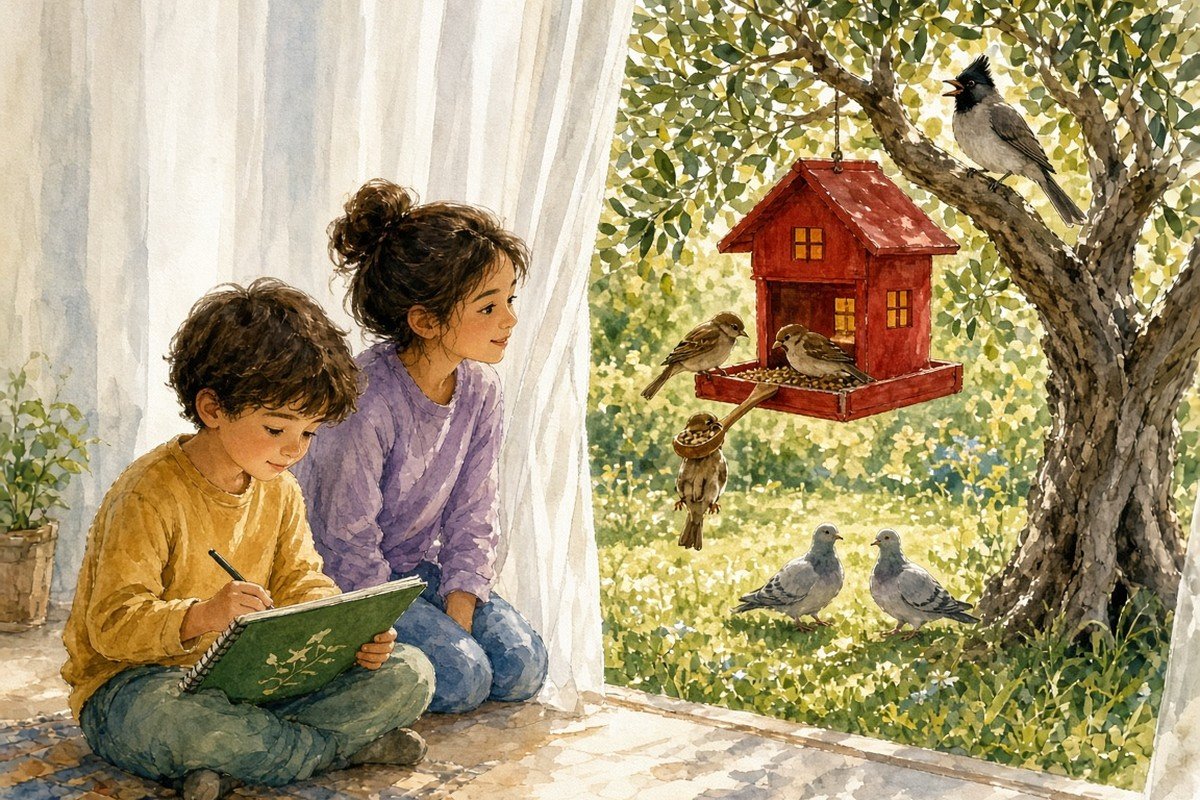
She led him to the big window in the living room, the one with the long white curtain. She pulled the curtain almost closed, so there was just a narrow gap. Then she sat down on the floor behind it and patted the cushion next to her.
"Sit," she whispered. "And don't make a sound."
Laith sat. Through the gap, he could see the olive tree and the red feeder swinging from its branch.
"Birds are small," Rahaf whispered. "Everything in the world is very big to them. When we run and shout and bang, it is like a giant stomping around. They get scared. But if we are still and quiet, they forget we are here."
"How long do we have to be quiet?" Laith whispered back.
"As long as it takes," said Rahaf.
So they sat. Laith tried very hard to be still. His nose itched, and he rubbed it slowly. His foot fell asleep, and he wiggled his toes inside his sock. The clock in the kitchen ticked. The breeze moved the leaves of the olive tree, and patches of sunlight danced on the grass.
Laith started to notice things he had never noticed before. A line of tiny ants was marching along the garden wall. A white butterfly was resting on the jasmine.
And then, very softly, there was a flutter.
A little brown sparrow landed on the garden wall. It hopped once. It tilted its head and looked at the red feeder. It hopped again.
Laith held his breath.
The sparrow flew to the olive tree. It landed on the branch right above the feeder. Then it fluttered down onto the wooden spoon perch, poked its head into the little square window, and came out with a seed in its beak.
Laith squeezed Rahaf's hand so hard that she squeaked, very quietly.
The sparrow ate one seed, then another, then another. Then a second sparrow came, and then a third. They chirped to each other in tiny voices. Cheep, cheep, cheep. One of them hung upside down from the bottom of the carton, flapping its wings to keep its balance.
Very slowly, Laith opened his green notebook. Very slowly, he picked up his brown pencil. And while the sparrows ate, he drew them. He drew their round heads and their short beaks and the little black patch on one sparrow's throat.
Then a different bird came. It was bigger than the sparrows, with a black head, a pointed crest, and a bright yellow patch under its tail.
"A bulbul," Rahaf breathed, barely making a sound.
The bulbul sat on the olive branch and sang. It was a bubbly, happy song, like water pouring from a jug. He drew the bulbul with its crest standing up proudly, and he colored the yellow patch with his brightest crayon.
They stayed behind the curtain all afternoon. By the time the sun turned golden, Laith had drawn three sparrows, one bulbul, and a pair of soft grey doves who walked on the grass below the feeder, pecking at the fallen seeds and cooing to each other.
When Mama called them for dinner, Laith tiptoed away from the window. He did not run. He did not shout. He just held his notebook against his chest and smiled.
At the dinner table, he opened it and showed everyone.
"These are the sparrows," he said. "This one hangs upside down. This is the bulbul. He is the one who sings in the morning. And these are the doves. They are married, I think, because they always stay together."
Baba laughed. "These are wonderful drawings, Laith. How did you get the birds to stay so long?"
Laith looked at Rahaf, and Rahaf winked at him.
"I gave them breakfast," said Laith. "And then I gave them quiet."
From then on, every afternoon after school, Laith sat behind the long white curtain with his green notebook on his knees. He filled the feeder every Saturday. And page by page, very quietly, MY BIRD BOOK began to fill with birds.