A story
Prophet Ismail and the Blessed Spring of Zamzam
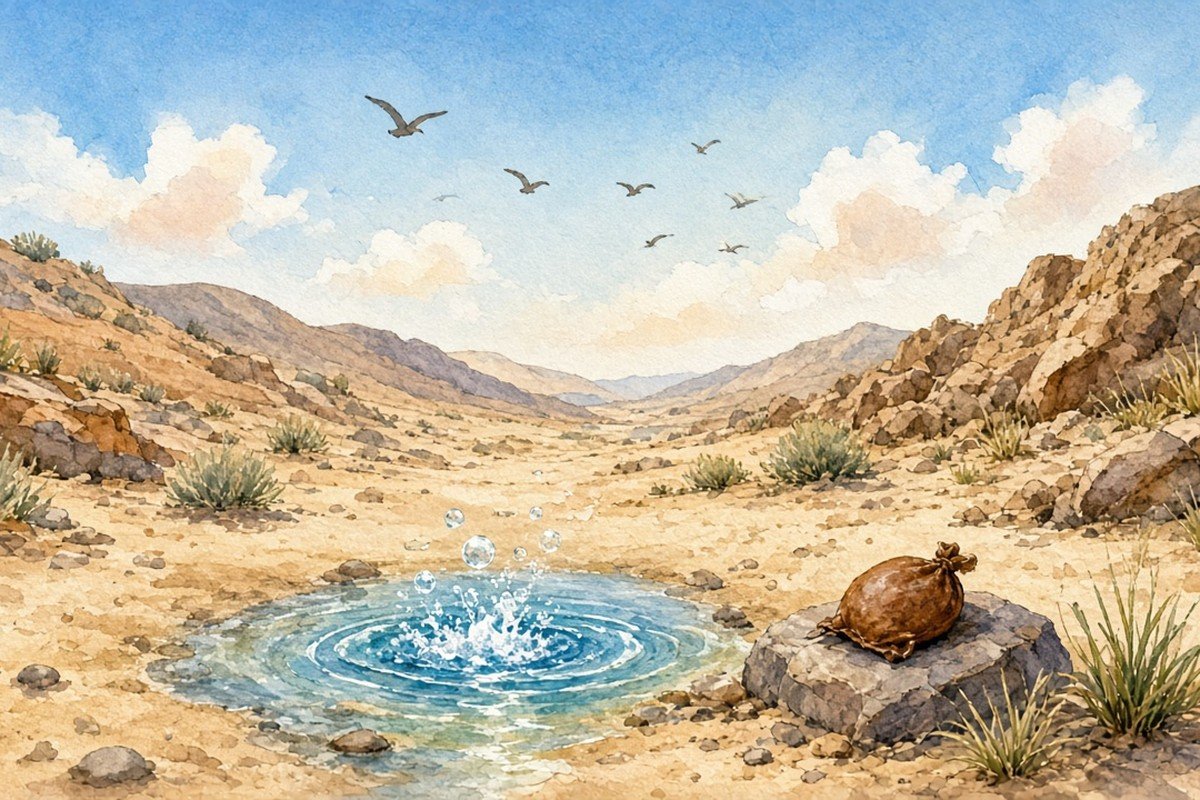
Long ago, in a dry and rocky valley, there were no houses. There were no trees. There was no river and no well. There was only sand, stones, and the hot sun shining down. This valley would one day be called Makkah.
One day, Prophet Ibrahim, peace be upon him, came to this valley. With him were his wife Hajar and their baby son, Ismail, peace be upon him.
Allah had commanded Ibrahim to leave Hajar and baby Ismail in this valley. Ibrahim left them some dates in a bag and some water in a water skin. Then he began to walk away.
Hajar followed him. "O Ibrahim," she asked, "where are you going, leaving us in this valley where there are no people and nothing at all?"
Ibrahim did not turn around. Hajar asked again and again. Then she asked a different question. "Did Allah command you to do this?"
"Yes," said Ibrahim.
Hajar's face became calm. "Then Allah will not let us be lost," she said.
This story is told in the hadith collection of Al-Bukhari, from Ibn Abbas, may Allah be pleased with him. Hajar trusted Allah with her whole heart.
Ibrahim walked on until he reached a high place where they could no longer see him. Then he turned toward the valley and raised his hands. He made a prayer. He asked Allah to take care of his family, to make people's hearts love them, and to give them fruits so that they would be thankful (Surah Ibrahim, 14:37).
Hajar sat with baby Ismail. She ate the dates and drank the water, and she fed her baby. But soon the water ran out. Hajar became thirsty. Baby Ismail became thirsty too, and he began to cry.
Hajar could not bear to see him crying. She looked around. Nearby was a small hill called Safa. She climbed up to the top and looked out across the valley. Was anyone there? Was there any water? She saw no one.
So she came down and ran across the valley to another small hill called Marwah. She climbed it and looked again. Still no one.
Back she went to Safa. Then back to Marwah. Again and again she went, seven times in all. She did not sit and wait. She tried her very best, and she trusted Allah to help.
When she reached Marwah the seventh time, she heard a sound. She listened carefully. Then she saw an angel at the place where baby Ismail was. By the command of Allah, water came gushing out of the ground!
Fresh, cool, clear water bubbled up from the dry sand. Hajar hurried to it. She made a little wall of sand around it, so the water would not run away. She scooped it into her water skin. She drank, and she gave water to her baby. Ismail stopped crying.
This was the spring of Zamzam. And do you know? The water of Zamzam still flows today, thousands of years later. Millions of people drink from it every year.
Muslims remember Hajar every time they go to Hajj or Umrah. They walk between the hills of Safa and Marwah seven times, just as Hajar did. They remember her trust in Allah and her hard work.
Soon birds came flying over the valley. Where there are birds, there is often water. A group of travelers, from a tribe called Jurhum, saw the birds. They followed them, and they found Hajar and her baby beside the spring.
They asked Hajar politely if they could stay near the water. Hajar agreed, but she said the water would remain hers. They were happy to agree. So they settled there and built their homes. The empty valley began to fill with life.
Ismail grew up among the people of Jurhum. He learned their Arabic language. He was a kind, honest boy, and everyone liked him. When he grew up, he married a woman from the tribe.
Ismail was known for keeping his promises. Allah praises him in the Quran. Allah says that Ismail was "true to his promise," and that he was a messenger and a prophet (Surah Maryam, 19:54). He told his family to pray and to give charity, and Allah was pleased with him.
Ibrahim came back to visit his son several times. Once, Ibrahim told Ismail that Allah had given him a great test. In a dream, Ibrahim saw that he was sacrificing his son. Ismail was not angry and he did not run away. He said, "O my father, do as you are commanded. You will find me, if Allah wills, among the patient" (Surah As-Saffat, 37:102). Allah saw that they were both ready to obey Him, and Allah sent a ram in Ismail's place. Ismail was safe and well. Every Eid al-Adha, Muslims remember this.
On another visit, Ibrahim said, "O Ismail, Allah has commanded me to do something. Will you help me?"
"I will help you," said Ismail.
Allah had commanded them to build a house of worship, the Kaaba, right next to the spring of Zamzam. So father and son worked together. Ismail carried the stones. Ibrahim set them in place, one on top of another. When the walls grew too high, Ibrahim stood on a stone to reach the top. That stone is still kept near the Kaaba today. It is called Maqam Ibrahim.
As they built, they prayed. They said, "Our Lord, accept this from us. You are the All-Hearing, the All-Knowing" (Surah Al-Baqarah, 2:127). They also asked Allah to send a messenger from among their children, to teach people. Many, many years later, Allah answered that prayer when He sent Prophet Muhammad, peace and blessings be upon him, who came from the family of Ismail.
The valley that was once empty and dry became a blessed place. There was water to drink. There were homes and families. And there was the Kaaba, where people would come to worship Allah alone.
Prophet Ismail, peace be upon him, grew up patient, truthful, and helpful. And his mother Hajar teaches us something too. When things are hard, we trust Allah, and we also try our very best. Allah never leaves alone those who trust Him.