A story
Prophet Salih and the Gentle She-Camel
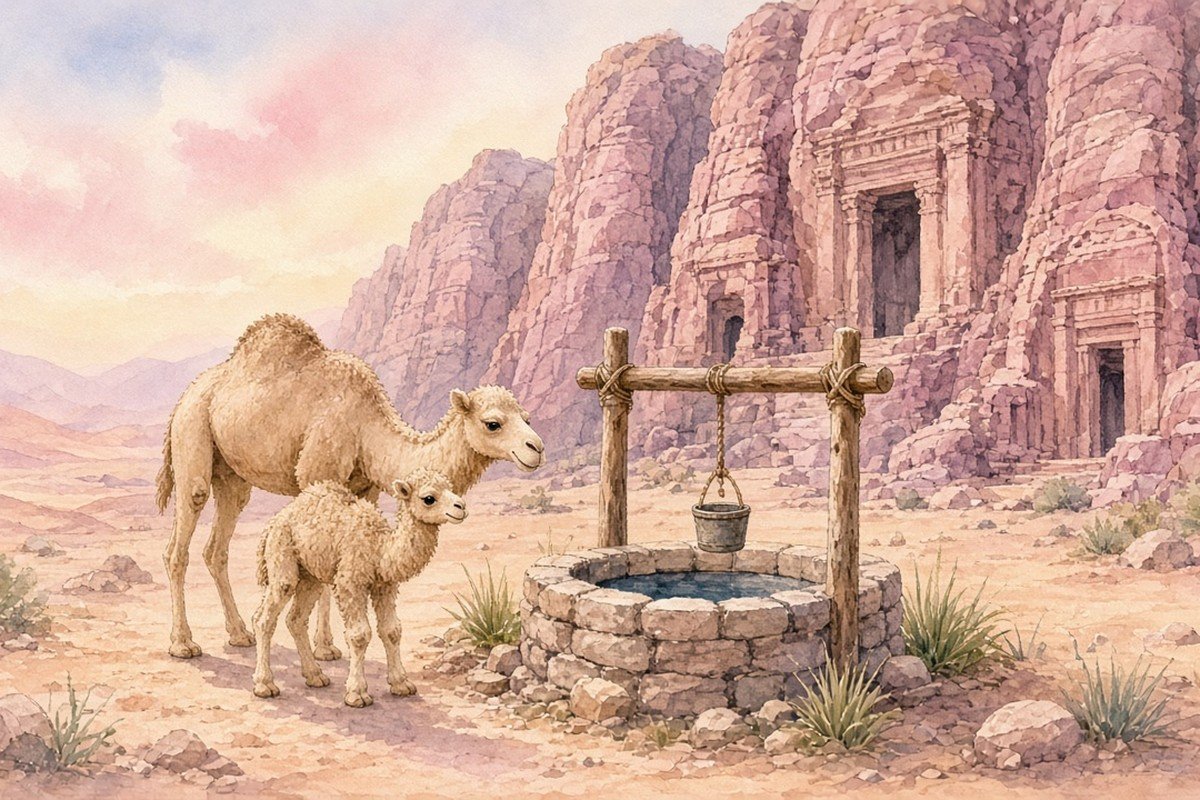
Long ago, in the north of Arabia, there lived a people called Thamud. They lived in a valley of tall red rocks. The people of Thamud were very clever builders. They carved great houses right into the sides of the mountains. They made big doorways and strong rooms out of solid stone. On the flat ground, they built palaces and planted gardens with date palms and springs of water.
Allah had given them so many good things. Water, gardens, fruit, and strong houses. But instead of thanking Allah, many of them became proud. They thought that their strength and their stone houses would keep them safe forever. They worshipped idols instead of Allah, and the strong ones were unkind to the weak.
So Allah chose a man from among them to be His prophet. His name was Salih, peace be upon him. Everyone in the town knew Salih. He was wise and good, and people used to have great hopes for him.
Salih said to his people, "O my people, worship Allah. You have no god other than Him. He made you from the earth and let you live in it. So ask Him for forgiveness, and turn back to Him. My Lord is near, and He answers" (Surah Hud, 11:61).
Some people believed him. Most of them were poor and humble. But the proud leaders did not like what Salih said.
"O Salih," they said, "we used to have hopes for you before this. Now you tell us to stop worshipping what our fathers worshipped?"
They laughed at him. Then they said, "If you are really a prophet, show us a sign. Bring a she-camel out of this rock!"
Salih turned to Allah and prayed. And Allah answered. By the command of Allah, a wonderful she-camel came out of the rock. She was big and beautiful and gentle. It was a miracle that everyone could see with their own eyes. She was called the she-camel of Allah, because she was a sign from Him.
Salih said to his people, "This is the she-camel of Allah, a sign for you. Leave her to eat freely on Allah's earth, and do not harm her" (Surah Al-A'raf, 7:73).
There was one more rule. The town had one well for water. Salih told them that they must share the water fairly. On one day, the she-camel would drink from the well. On the next day, the people would drink. "She has a turn to drink, and you have a turn to drink, each on a known day" (Surah Ash-Shu'ara, 26:155).
The scholars of tafsir tell us that on the camel's day, she gave so much milk that there was enough for everyone in the town. So the people still had plenty to drink. Allah's sign was a blessing for them!
For a while, everyone lived side by side with the she-camel. She walked quietly through the rocky valley. She ate the plants and grass. Children watched her pass by. She never bothered anyone.
The believers loved her. When they saw her, they remembered Allah's power and Allah's kindness.
But the proud leaders were not happy. Every time they saw the she-camel, they remembered that Salih was right. They did not want to share the water. They did not want to follow Salih. Their hearts were full of pride.
So a group of them made a very bad plan. They decided to hurt the she-camel. The worst of them went out and harmed her, and the she-camel died. The others agreed and cheered him on. It was a cruel and wrong thing to do, against an innocent animal and against Allah's clear sign.
Then the proud ones went to Salih. "O Salih," they said, "bring us what you warned us about, if you really are a prophet!"
Salih was very sad. He said, "Enjoy yourselves in your homes for three days. That is a promise that will not be broken" (Surah Hud, 11:65). He gave them three days. Three days to say sorry. Three days to come back to Allah.
But the proud ones did not say sorry. They did not change their hearts.
So after three days, Allah's punishment came, just as Salih had warned. A mighty blast came upon the people who had done wrong, and their stone houses could not protect them. The valley became quiet and empty.
But Allah saved Salih and the believers who were with him. Allah says, meaning: "We saved Salih and those who believed with him, by a mercy from Us" (Surah Hud, 11:66). They went on to live in peace, worshipping Allah.
Before he left, Salih looked at the empty valley. He said, "O my people, I gave you my Lord's message, and I gave you good advice. But you did not love those who gave you good advice" (Surah Al-A'raf, 7:79).
Today, the carved stone houses of that valley are still standing. Travelers can see the doorways cut into the red rock. The scholars call the place Al-Hijr. When our Prophet Muhammad, peace and blessings be upon him, passed by it, he told his companions to go by humbly, remembering Allah, and not to make it a place of fun.
The story of Prophet Salih, peace be upon him, teaches us many things. It teaches us to be thankful for what Allah gives us, and not to be proud. It teaches us to share fairly, so that everyone gets their turn.
And it teaches us something very important about animals. The she-camel could not speak. She could not defend herself. She was a creature of Allah, and Allah told the people to treat her well. When we are gentle with animals, give them water, and never hurt them, we are obeying Allah.
So the next time you see a cat, a bird, or a camel, remember the gentle she-camel of Prophet Salih. Be kind to it. Give it some water if it is thirsty. And remember that Allah loves those who are kind to His creatures.