A story
Prophet Shuayb and the Fair Scales
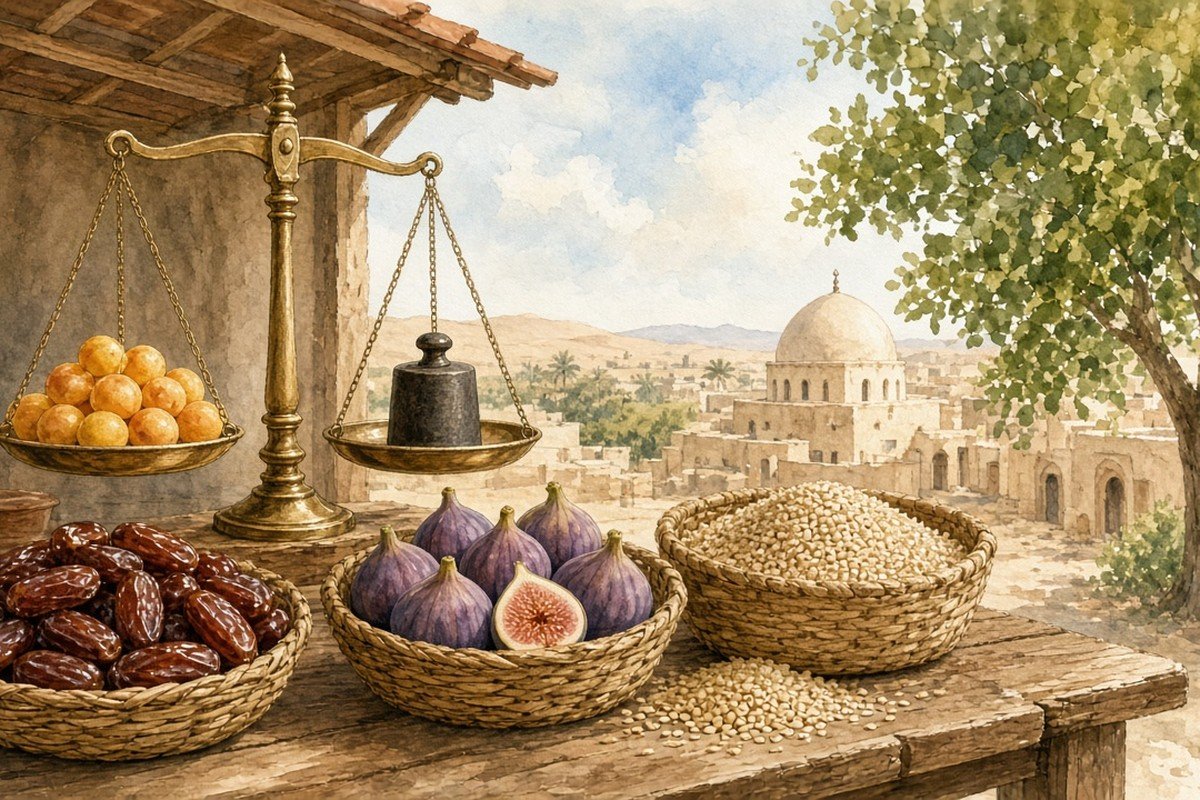
Long ago, there was a busy town called Madyan. It was on an important road where many caravans passed by. Travelers came with camels loaded with goods. They stopped in Madyan to rest, to buy, and to sell.
The market of Madyan was a noisy, colorful place. There were baskets of dates and figs. There were sacks of wheat and barley. There were bowls of bright spices, red and yellow and brown. And in the middle of every stall stood a set of scales, for weighing things.
A scale has two pans, one on each side. You put the food on one side. You put a weight on the other side. When the two sides are level, the amount is fair.
But the people of Madyan had a bad habit. Many of them cheated. When they sold food, they used tricks to give a little less than they should. A little less wheat. A little less barley. A few dates missing. And when they bought food from others, they wanted more than was fair.
Some of them also waited on the roads and frightened travelers, taking things that were not theirs. And they worshipped idols instead of Allah.
So Allah sent them a prophet from among them. His name was Shuayb, peace be upon him. He spoke so clearly and beautifully that some scholars called him "the speaker among the prophets."
Shuayb said to his people, "O my people, worship Allah. You have no god other than Him. And do not give less in measure and weight. I see that you are doing well, and I fear for you the punishment of a day that will surround you" (Surah Hud, 11:84).
He went on, "O my people, give full measure and weight, with fairness. Do not take away what belongs to people, and do not spread trouble in the land" (Surah Hud, 11:85).
Shuayb also told them something very wise. He said that what is left over for them, from honest and fair trade, is better for them, if they truly believe (Surah Hud, 11:86). In other words, a little money that is earned honestly is better than a lot of money that is earned by cheating. Allah puts blessing in what is honest.
Some people listened and believed. They began to use fair scales. When they weighed wheat, they made sure the pans were level. When a customer paid for a full basket, they gave a full basket.
But the proud ones laughed at Shuayb. They said, "O Shuayb, does your prayer tell you that we must leave what our fathers worshipped, or that we cannot do what we like with our own money?" (Surah Hud, 11:87).
They thought that their money was only their own business. They did not understand that cheating hurts other people. When the seller cheats, a family goes home with less food than they paid for.
Shuayb answered them gently and wisely. He told them that Allah had given him good things too, honest and clean. He said that he would never tell them not to do something and then do it himself. Then he said, "I only want to make things better, as much as I can. My success comes only from Allah. In Him I trust, and to Him I turn" (Surah Hud, 11:88).
Shuayb reminded them of what had happened to the people of Nuh, of Hud, and of Salih before them. He told them that it was not too late. "Ask your Lord for forgiveness, then turn back to Him. My Lord is Most Merciful and Most Loving" (Surah Hud, 11:90).
What a kind message! Allah was ready to forgive them, if only they would stop cheating and come back to Him.
But the proud leaders would not listen. They said, "O Shuayb, we do not understand much of what you say. And if it were not for your family, we would have driven you away." They even threatened to throw Shuayb and the believers out of the town, unless they returned to the old ways.
Shuayb said, "My people, is my family more important to you than Allah?" He did not give up his message, and the believers did not give up their faith. They stayed honest, even when it was hard.
Shuayb told his people, "Do what you will, and I will do what I must. Soon you will know" (Surah Hud, 11:93).
Then, after a long time of warnings, Allah's punishment came to those who refused and kept cheating, as it had come to the nations before them. The market of Madyan, once so noisy, became silent.
But Allah saved Shuayb and those who believed with him, by His mercy (Surah Hud, 11:94).
Shuayb looked back at his old town with a sad heart. He had given them every chance. He said, "O my people, I gave you the messages of my Lord, and I gave you good advice" (Surah Al-A'raf, 7:93).
Shuayb and the believers lived on in peace, worshipping Allah, buying and selling fairly, and helping one another.
Today, our Prophet Muhammad, peace and blessings be upon him, also taught us to be fair in buying and selling. He taught that when a buyer and a seller are truthful and honest with each other, their trade is blessed (Al-Bukhari and Muslim). And in the Quran, Allah says, meaning: "Woe to those who give less" (Surah Al-Mutaffifin, 83:1), about people who cheat when they measure and weigh.
So the next time you share sweets with your brother or sister, think of the fair scales of Prophet Shuayb. Are both sides even? Did everyone get their fair share?
When you play a game, think of Shuayb. Are you following the rules, even when nobody is watching?
When you grow up and buy and sell things, think of Shuayb. Give people what they paid for. Never hide a little bit for yourself.
Prophet Shuayb, peace be upon him, teaches us that honesty is better than all the money in the world. Being fair makes people trust us. It makes our hearts clean. And most of all, Allah loves those who are fair.