A story
Twig the Stick Insect Who Wanted Everyone to Notice Him
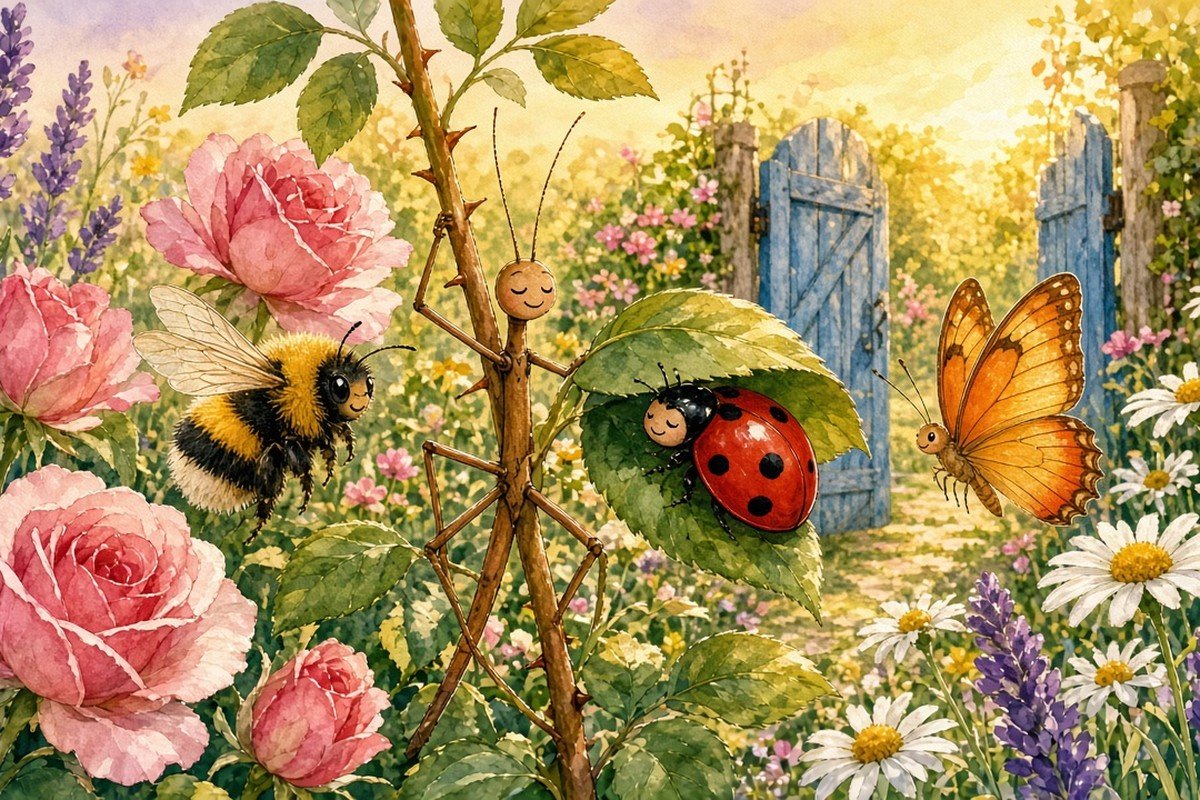
In a sunny garden, on a rose bush beside a blue gate, there lived a little stick insect named Twig.
Twig was long and thin and brown. He had six skinny legs, two long feelers, and a body that looked exactly like a small dry stick. When he held very still on a branch, nobody could tell that he was there at all. Not the birds. Not the bees. Not even the gardener, who sometimes snipped roses right next to him.
Twig's mother said this was a wonderful gift. "Being hard to see keeps us safe," she said. "We are the quiet ones of the garden."
But Twig did not want to be quiet. He wanted to be noticed.
Every day he watched the other creatures in the garden. He watched the ladybird, who was bright red with neat black spots, and everybody said, "Oh, how pretty!" He watched the butterfly, who had wings of orange and gold, and everybody said, "Oh, how beautiful!" He watched the bumblebee, who was fuzzy and striped and hummed a loud, happy song, and everybody said, "Oh, here comes Bumble!"
Nobody ever said, "Oh, look, it's Twig!"
"Maybe," said Twig to himself one morning, "if I had spots like the ladybird, everyone would notice me."
So he crawled down to the muddy corner of the garden, where the hose dripped. He dipped the end of his feeler in the mud and dabbed little round dots all down his body. Dab, dab, dab.
Then he climbed back up the rose bush and sat in the middle of a big green leaf, where everyone could see him.
The ladybird flew past. She stopped and stared.
"Twig?" she said. "Why do you have mud all over you?"
"They're spots," said Twig proudly. "Like yours."
The ladybird tried very hard not to giggle. "They're very... brown," she said kindly.
Just then, a few drops of rain pattered down from a passing cloud. Plip, plop. The mud spots ran down Twig's legs in little brown rivers and dripped off his feet. In a moment, they were gone.
Twig sighed.
"Maybe," he said, "if I had wings like the butterfly, everyone would notice me."
So he found two pink rose petals that had fallen on the ground, and he tucked them on his back, one on each side. He climbed to the top of the bush and flapped his long arms up and down.
The butterfly floated by. "Twig?" she said. "Are you wearing petals?"
"They're wings," said Twig, flapping hard. "Like yours."
A little breeze blew through the garden. Whoosh! It caught the petals and carried them away over the blue gate, twirling and spinning. Twig wobbled on his branch and nearly fell off.
He sighed again.
"Maybe," he said, "if I could hum like the bumblebee, everyone would notice me."
He took a deep breath. "Hmmmmmm," he hummed. But stick insects are not made for humming. All that came out was a tiny squeak, like a door that needs oil. A beetle walking past looked around, puzzled, and then shrugged and walked on.
Twig climbed back to his favorite branch and held very still. He felt small and plain and quite sad.
That afternoon, the garden was busy. The bees buzzed in the lavender. The butterflies drifted over the daisies. The ladybird was having a nap on a leaf, all curled up with her spots shining in the sun.
And then a shadow passed over the garden.
It was a big, curious bird with a yellow beak, and it was looking for something to nibble. It landed on the blue gate and peered at the rose bush with one round, shiny eye.
Twig froze. He held so still that he did not even wiggle a feeler. He looked exactly like a stick.
The bird's eye moved right past him. But then it stopped on the ladybird, sleeping on her leaf, bright and red and easy to see.
Twig's heart beat fast. He had to do something. He could not hum. He did not have wings. But he could do one thing that nobody else in the garden could do.
Very slowly, so slowly that he looked like a branch swaying in the wind, Twig stretched out one long, thin leg. Then another. He crept along the stem, as quiet as a shadow, until he reached the ladybird's leaf.
"Wake up," he whispered. "Hide under the leaf. Quickly and quietly."
The ladybird opened her eyes. She saw the bird. Without a sound, she slipped underneath the leaf where no one could see her.
The bird looked and looked. It saw leaves. It saw roses. It saw some sticks. Then it fluffed its feathers, gave a bored little chirp, and flew away over the rooftops.
The ladybird crawled out from under the leaf. Her eyes were very wide.
"Twig," she said, "you saved me! How did you get here without that bird seeing you?"
"I'm good at being a stick," said Twig shyly.
By now the butterfly and the bumblebee had come to see what had happened. The ladybird told them everything. How Twig had crept along the stem. How the bird had looked right at him and seen nothing at all. How he had whispered just in time.
"That's amazing," buzzed the bumblebee. "I could never sneak anywhere. Everybody hears me coming."
"And I could never hide," said the butterfly, folding her bright wings. "Everybody sees me."
"I wanted to be like all of you," said Twig. "I tried spots and wings and humming. But nothing worked."
The ladybird smiled. "We don't need another ladybird," she said. "We need a Twig."
That evening, Twig sat on his favorite branch in the golden light. He did not have spots or wings or a loud hum. But he did have friends, and they knew exactly where to find him.
"Goodnight, Twig!" called the ladybird from her leaf.
"Goodnight, Twig!" buzzed the bumblebee from the lavender.
"Goodnight, Twig!" whispered the butterfly from the daisies.
Twig smiled a small stick-insect smile and held very, very still. Nobody in the garden could see him at all.
But everyone knew he was there.