A story
The Mice Who Ate the Iron (from Kalila and Dimna)
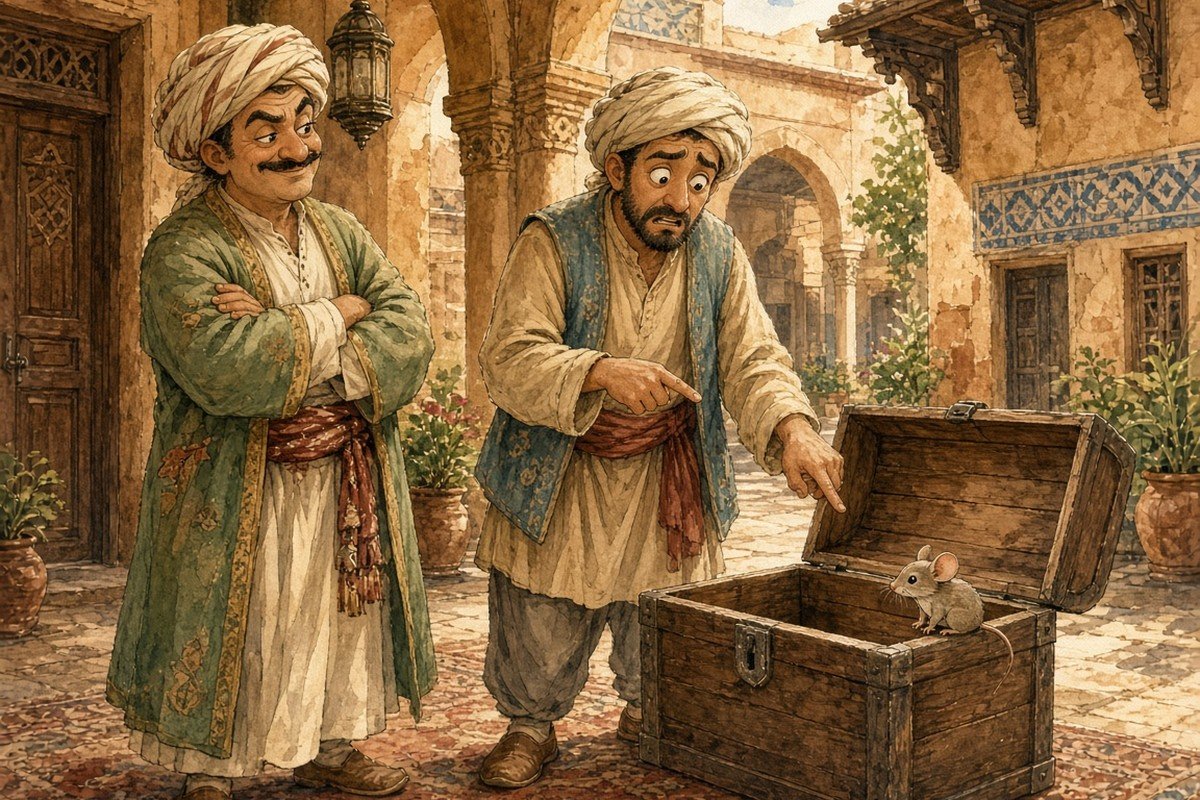
Once upon a time, in an old city of sandy-colored houses and busy markets, there lived a merchant named Tajir.
Tajir traveled far and wide. He rode his camel across deserts and over mountains. He had a curly mustache, a green robe with golden stitching, and a twinkle in his eye.
One day, Tajir was getting ready for a very long journey.
"I will be gone for a whole year," he said. "But what shall I do with my iron?"
Tajir had a heavy wooden chest. Inside it were one hundred bars of iron. They were gray and strong and very valuable. Tajir had saved for many years to buy it.
"I cannot carry it on my camel," said Tajir. "It is much too heavy. I will ask my friend Bakhil to keep it safe for me."
So Tajir went to his friend's house. Bakhil lived in a big house with a tiled courtyard, a fountain, and pots of red flowers.
"Bakhil, my friend," said Tajir. "Will you look after my chest of iron while I am away?"
"Of course!" said Bakhil, with a big smile. "I will guard it like my own treasure. Do not worry about a thing."
The two friends shook hands. Tajir climbed onto his camel and rode off into the desert.
Now, Bakhil was not a wicked man. But he was a little bit greedy. And after a few weeks, he began to look at that chest of iron.
"A hundred bars of iron," he said to himself. "That is worth a lot of gold. Tajir will not be back for a whole year. Maybe he will forget all about it."
So one night, Bakhil quietly carried the iron to the market. He sold every last bar. Then he put the empty chest back in the corner and threw a cloth over it.
The year went by. The seasons changed. And one day, Tajir came riding home on his camel, dusty and happy.
He went straight to Bakhil's house.
"Welcome home, my friend!" said Bakhil, a little too loudly. "How was your journey?"
"Wonderful," said Tajir. "And now I have come for my iron."
Bakhil's smile wobbled. He shuffled his feet. He tugged at his beard.
"Ah," he said. "Your iron. Well. You see. There is a small problem."
He led Tajir into the courtyard. He pulled the cloth off the chest. He opened the lid.
It was empty.
"I am so sorry," said Bakhil, pointing into the chest. "Mice ate it."
Tajir raised one eyebrow. "Mice?" he said.
"Yes," said Bakhil quickly. "Hungry mice. Hundreds of them. They came in the night. Nibble, nibble, nibble. And by morning, all one hundred bars of iron were gone."
Just then, a tiny gray mouse popped up on the edge of the chest. It sniffed the air. It twitched its whiskers.
"See!" said Bakhil, pointing at it. "There is one now!"
The little mouse looked at Bakhil. It looked at Tajir. Then it scurried away to find a nice crumb of bread.
Tajir looked at the empty chest. He looked at Bakhil. He knew perfectly well that mice cannot eat iron. Mice eat seeds, and cheese, and crumbs. Iron is as hard as rock.
But Tajir did not shout. He did not get angry. He just smiled slowly and stroked his curly mustache.
"Well, well," said Tajir. "Mice that eat iron. How very unusual. I suppose these things happen."
Bakhil let out a big breath. "Yes," he said. "Yes, they do. I am so glad you understand."
Tajir said goodbye and walked out of the courtyard. But he was thinking. And by the time he reached the street, he had a plan.
Outside, Bakhil's young son Yusuf was playing with a ball by the fountain. Yusuf loved Tajir. Tajir always brought him stories from his travels.
"Uncle Tajir!" cried Yusuf. "You are back!"
"Hello, Yusuf," said Tajir, kneeling down. "How would you like to come to my house for the afternoon? My wife has made honey cakes. And I have a little wooden camel I brought back just for you."
"Yes, please!" said Yusuf.
So Tajir sent word to Yusuf's mother, so she would know where he was. And Yusuf spent a happy afternoon at Tajir's house, eating honey cakes and playing with his new wooden camel.
Then Tajir walked back to Bakhil's house.
Bakhil was in the courtyard, looking all around. "Tajir!" he said. "Have you seen my son? I cannot find him anywhere!"
Tajir shook his head sadly. "Oh, Bakhil," he said. "I am afraid I have some strange news. As I was leaving, I saw a hawk swoop down from the sky. It picked up your son and flew away with him, over the rooftops."
Bakhil stared at him. His mouth fell open.
"A hawk?" he said. "A hawk carried away my son? That is impossible! A hawk is just a bird! It could never lift a whole boy!"
Tajir smiled.
"My dear friend," he said gently. "In a city where mice can eat iron, surely a hawk can carry a boy."
Bakhil opened his mouth. Then he closed it. Then he opened it again.
His face turned red. Then pink. Then he looked down at his shoes.
He understood.
"Oh, Tajir," he said quietly. "Mice did not eat your iron. I sold it. I was greedy, and then I told you a silly fib. I am very sorry."
Tajir put a hand on his shoulder.
"Thank you for telling the truth," he said. "That was the hardest part."
"I will pay you back," said Bakhil. "Every single coin. Right now."
He went inside and came out with a heavy bag of gold. It was enough to buy one hundred bars of iron, and a little bit more besides.
"And your son," said Tajir, "is safe and happy at my house, eating honey cakes. Come. Let us go and get him together."
So the two friends walked down the street side by side. When they got to Tajir's house, Yusuf came running out, with honey on his chin and a wooden camel in his hands.
"Papa!" he cried. "Look what Uncle Tajir gave me!"
Bakhil picked up his son and hugged him tight.
That evening, both families sat together in Tajir's garden. They ate honey cakes and drank mint tea. They laughed about mice and hawks until the stars came out.
And in the corner, the little gray mouse found a crumb of honey cake. It nibbled it happily.
Because, of course, that is what mice really eat.