A story
Prince Qamar and the Flying Ebony Horse (from One Thousand and One Nights)
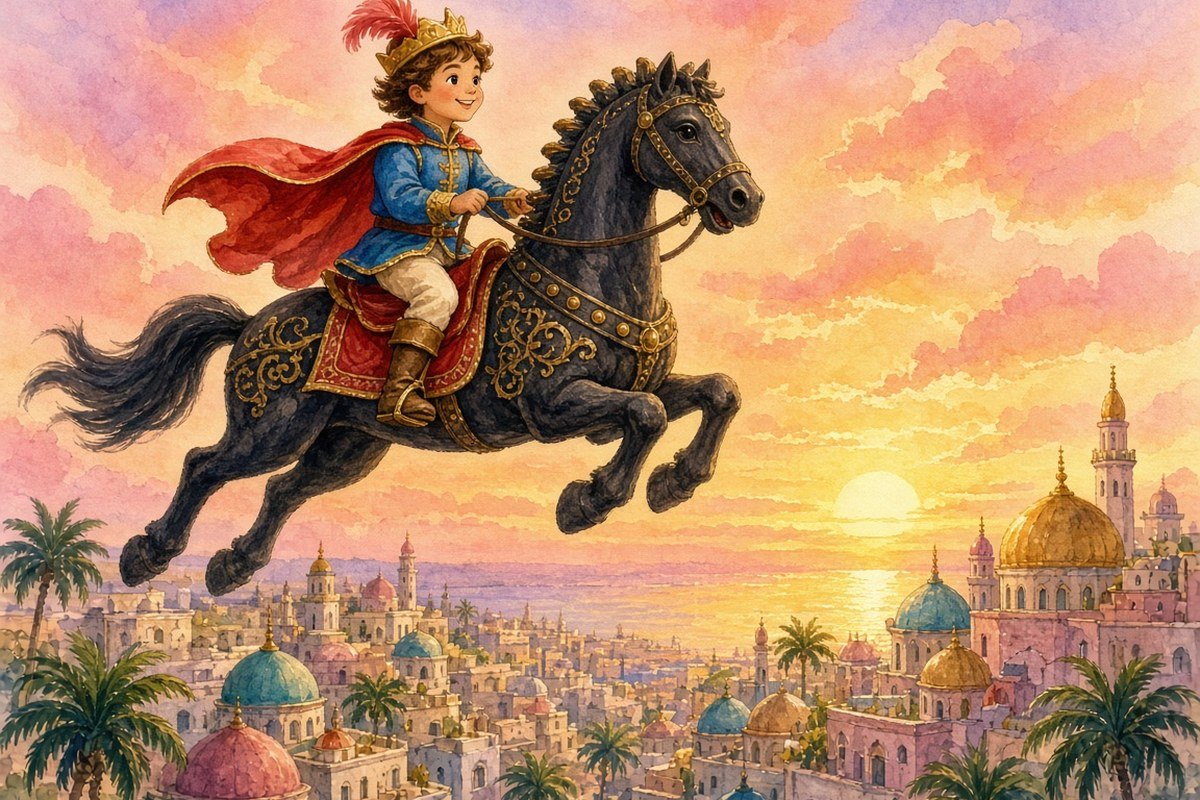
Long ago, in the land of Persia, there was a King who loved clever inventions. Every year, on the first day of spring, inventors came from near and far to show him their wonders.
That spring, two inventors came. The first brought a golden peacock that sang a song every hour. The King clapped his hands with delight.
The second inventor was an old man with a long gray beard and a grumpy face. He led in a horse made of shiny black ebony wood. It had a saddle of red velvet and a bridle covered in tiny gold stars. On its neck, there were two small wooden pegs.
"This horse can fly," said the old inventor. "It can carry a rider anywhere in the world in a single day."
The King's son, Prince Qamar, stepped forward. He was young and brave and very, very curious. "May I try it, Father?" he asked.
Before anyone could answer, Prince Qamar jumped into the saddle. He saw the peg on the right side of the horse's neck, and he gave it a turn.
Whoosh! The ebony horse leaped into the air. It flew up past the palace towers, up past the clouds, and away across the sky.
"Wait!" cried the old inventor. "Come back! I have not shown you how to come down!"
But the prince was already too high to hear.
At first, Prince Qamar laughed with joy. The wind rushed through his hair. Far below, rivers looked like silver ribbons, and towns looked like toy blocks. But after a while, he wanted to land. He pulled on the bridle. The horse kept flying up. He turned the right peg again. The horse flew higher still.
"Oh dear," said the prince. "I was in such a hurry that I did not wait to learn how this works."
Prince Qamar took a deep breath. He made himself calm down. "If I cannot rush my way out of this," he said, "I will have to look carefully." Slowly and patiently, he ran his hands all over the horse's neck. There, on the left side, hidden under the mane, was a second small peg. Gently, he turned it.
The horse began to float softly downward, like a leaf in autumn. The prince smiled. "Thank you," he whispered to the horse.
By now, the sun was setting. The ebony horse landed on the flat roof of a beautiful white palace in a city the prince had never seen. The prince climbed down from the horse and peeked over the edge of the roof.
In a garden below, a young woman was reading by the light of a lantern. It was Princess Shams, the daughter of the King of that land. She looked up and saw the prince on the roof, with his funny wind-blown hair. She was surprised, but she was not afraid. She laughed.
"Who are you?" she called. "And how did you get onto my roof?"
"I am Prince Qamar," he called back. "And I came on a flying horse, though I did not quite plan to."
The princess invited him down for tea. They talked for hours about books, stars, and faraway places. Soon they were the best of friends. Princess Shams wanted to see the prince's home, and the prince wanted his father to meet her.
"We will ask your father first," said Prince Qamar, because now he had learned not to rush into things.
Princess Shams's father, the King, listened to the story. He was surprised, but he liked the polite young prince. "You may visit Persia," he said, "as long as you come back to tell me all about it."
So the prince and the princess climbed onto the ebony horse. The prince turned the right peg, and they rose into the sky. When they reached Persia, the prince turned the left peg, and they landed softly in a garden outside his father's city.
"Wait here and rest," the prince said to the princess. "I will go and tell my father the good news, and then we will come back for you with music and flowers."
But the old inventor had been waiting in that garden. He was still grumpy because the prince had flown away on his horse without asking. When the prince had gone, the inventor came up to the princess.
"The prince has sent me to fetch you," he said. It was not true. He helped the princess onto the horse, climbed on behind her, and turned the peg. Up they flew.
"I will take you far away," the inventor grumbled, "and then the prince will be sorry he took my horse."
They flew to a land called Rum, and they landed in a meadow. There, the King of Rum was out hunting with his friends. He saw the princess looking upset. "Is this old man your grandfather?" he asked.
"No," said the princess. "He tricked me. Please help me get back to my friend, Prince Qamar."
The King of Rum told his guards to keep the inventor in a quiet room in his palace until things were sorted out.
Meanwhile, Prince Qamar had come back to the garden and found the princess gone. He did not panic. He thought carefully. He asked everyone he met if they had seen a black horse in the sky. At last, a merchant told him he had seen it land in Rum.
So the prince traveled to Rum, dressed as a simple traveler. When he reached the King's palace, he explained everything politely. The princess ran to meet him, and they hugged.
Then the prince went to see the old inventor. The inventor looked down at the floor. "I was angry," he mumbled. "You took my horse without asking."
"You are right," said Prince Qamar. "I should have asked, and I should have listened. I am sorry. And I am sorry you were not thanked for your wonderful invention."
The inventor looked up in surprise. Nobody had ever said sorry to him before. His grumpy face softened. "I am sorry too," he said. "I should not have tricked the princess."
The prince, the princess, and the inventor all flew home together on the ebony horse, very carefully. In Persia, the King gave the old inventor a workshop of his own, full of tools. And whenever someone new wanted to ride the flying horse, Prince Qamar would say, "First, sit down and listen. Let me show you both pegs."