
📖 Story
In the year 2090, the city of Blue Oasis was one of the most beautiful cities in the world. Its houses were covered with shiny solar panels, its gardens hung from the rooftops of towers, and its quiet trains glided over magnetic rails without a sound. In this city lived a girl named Jood, ten years old, who loved science and space and collected wires, screws, and books in her room.
Jood had a very special friend, a little robot named Najm. Najm was the size of a cat, round like a silver ball, with two blue eyes on a small screen, and he floated a little above the ground on a quiet propeller. He loved questions, and whenever he didn't understand something, he said, "Insufficient information! I need another question!" and Jood would laugh.
For all the city's beauty, there was one problem that worried everyone: water. The city was in the heart of the desert, the summers were very hot, and the hanging gardens drank lots of water, half of which was lost in the air. Jood's grandmother, Grandma Nawal, would say as she watered her mint on the balcony, "In my day we knew the value of every drop. Water is life, Jood, and whoever wastes it wastes a little bit of life."
One morning, Ms. Hala announced to the class, "Children, the Young Inventors Contest will be held in a month. The winner will go on a trip to the moon station!" The children shouted with joy, and Jood's heart leapt in her chest. She whispered to Najm, "The moon station, Najm! We have to invent something amazing!" His eyes lit up. "Analysis: excitement probability one hundred percent!"
That night, Jood sat on the balcony with her grandmother and saw drops of water trickling from the mint pot onto the floor. An idea came to her. "Grandma, what if a plant knew when it was thirsty and asked for water by itself?" Her grandmother laughed. "A talking plant? That's make-believe!" But Jood said, "No, Grandma, it's science!"
Jood and Najm started work the next day. They designed a small device with thin fingers that went into the soil near the roots to measure moisture. When the soil dried out, the device sent a signal to Najm, who opened a tiny tube that dripped water drop by drop right at the roots, without wasting any. They named it "Smart Roots."
But the first experiment didn't work. The tube opened the water and never closed it, so the pot filled up and overflowed onto the balcony, and a poor ant went sailing away on a leaf. "Error! Error! Small flood!" cried Najm. In the second experiment, the tube never opened at all, and two mint leaves wilted. In the third, a wire broke, and everything shut off.
Jood sat on the floor with soil on her hands and said sadly, "Maybe my idea is silly, Najm. Maybe I'm not meant to be an inventor." Najm floated in front of her face, a picture of a light bulb appeared on his screen, and he said, "Important information: the inventor Thomas Edison tried more than a thousand times before the light bulb lit up. He used to say: I haven't failed; I've found ways that don't work." Jood smiled in spite of herself.
Grandma Nawal came carrying two glasses of lemonade and sat down beside her. "Jood," she said, "when I planted my first lemon tree, it died. The second one died too. The third is the one that gives us this juice today." She patted her shoulder. "Failure isn't the end of the road. It's a sign that says: try from here."
Jood went back to work. She wrote every mistake in a notebook, and beside it what she had learned from it. She added a valve that shut itself after a set number of drops, covered the wires with a waterproof sleeve, and made the device run on a small solar panel. After two weeks, one bright morning, a little green light came on, the tube dripped exactly five drops, and then it stopped. "It worked!" Jood shouted. "Najm, it worked!" Najm spun around three times and said, "Joy at one thousand percent!"
In the second week, things became fun. Najm recorded the soil moisture every hour and showed it on his screen as a zigzag line, and Jood drew little pictures of mint leaves next to it: a sad leaf when the soil was dry, and a smiling leaf after watering. Together they discovered that the plant got thirstier at noon and less so at night, so they programmed the device to water early in the morning, when less water evaporates. "Even plants have schedules, Najm!" said Jood. "New information stored!" said Najm.
The day of the contest came, and the big science hall filled with young inventors and their families. There was a robot that folded clothes, a little drone that collected trash from beaches, and a hat that cooled your head in the heat. Jood placed the mint pot on her table with the Smart Roots planted in it, and Najm floated proudly beside her.
At the next table, a boy named Malik was showing a system for cleaning rainwater. Malik was a strong competitor, and he had been telling everyone he would win. But a few minutes before the judges arrived, Jood heard a pop and saw a wisp of smoke coming from Malik's device. It shut off, and Malik stood there pale, his eyes filling with tears. "The battery burned out!" he said. "It's all over!"
Jood looked at Malik's device, then at the judges starting to enter the hall. Najm whispered, "Alert: if we help him, we may not have time to prepare our own presentation." Jood thought for a moment, then remembered what her grandmother had said about water and life. "Najm," she said, "science exists to help people, not just so we can win alone. Come on!"
Jood took the spare solar panel out of her bag, and Najm stretched out his little arm to check the wires. "We'll connect your device to this panel in the light by the window," Jood told Malik. Malik looked at her in astonishment. "Why are you helping me? We're competitors!" Jood smiled. "Because your device is a great idea, and the city needs all our ideas." Two minutes later, Malik's device was working again, with clean water dripping from it.
Before the judges began, Malik came over to Jood and said quietly, "Jood, I kept telling everyone I would win, and I thought the others were my enemies. But today you taught me something no book ever taught me." Jood held out her hand and shook his. "Maybe next time we can invent something together: a machine that cleans rainwater and then uses it to water the roots!" Malik's eyes shone. "What a great idea!"
The judges went from table to table, asking questions and taking notes. When they reached Jood, she explained Smart Roots and showed them her whole notebook of mistakes. "These are thirteen failed experiments," she said, "and each one taught me something." Then Malik called from the next table, "And she helped me a little while ago, when my device burned out." The judges exchanged glances and wrote something on their papers.
At the end of the day, Ms. Hala stood on the stage and said, "The winner of the contest is an invention that saves water and teaches us patience, made by someone who understood that science is teamwork before it is competition: Jood and Najm, and Smart Roots!" Everyone applauded, and Malik clapped loudest of all. The judges also announced a special prize for Malik, because his idea deserved to be developed.
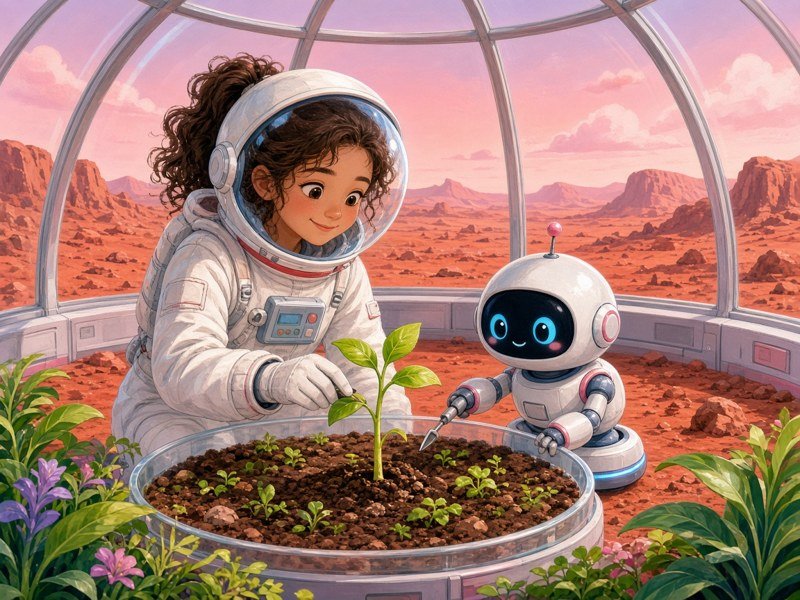
A month later, Jood sat in a small spacecraft heading for the moon station, with Najm strapped in by a seatbelt beside her. Through the window she watched the blue Earth grow smaller. In her bag was a little pot of mint with Smart Roots planted in it, to be the first mint watered that way on the moon. "You know?" she said to Najm. "If the first experiment had worked, I wouldn't have learned all this." "Sufficient information!" said Najm.
Jood learned that failure is not a shame but a step that brings us closer to success, if we learn from it and don't give up, and that science is at its most beautiful when we use it to help others and protect the gifts of the Earth. Whoever is patient, works with others, and lends a hand even in a competition wins twice: once with the prize, and once with people's hearts.



💬 Comments (0)
Add a comment
No comments yet. Be the first to comment.