📖 Story
On Sunday, Ms. Suad stood in front of the third grade and said: Children, our project this week is different. We will not only draw and write; we will listen. Each of you will choose a nearby place, record its sounds, then discover the story behind those sounds and tell it to us on Thursday. Rana raised her hand quickly and said: Miss, may I choose the neighborhood garden? It has lots of sounds! The teacher smiled and said: A wonderful idea, Rana. I cannot wait to hear what you discover.
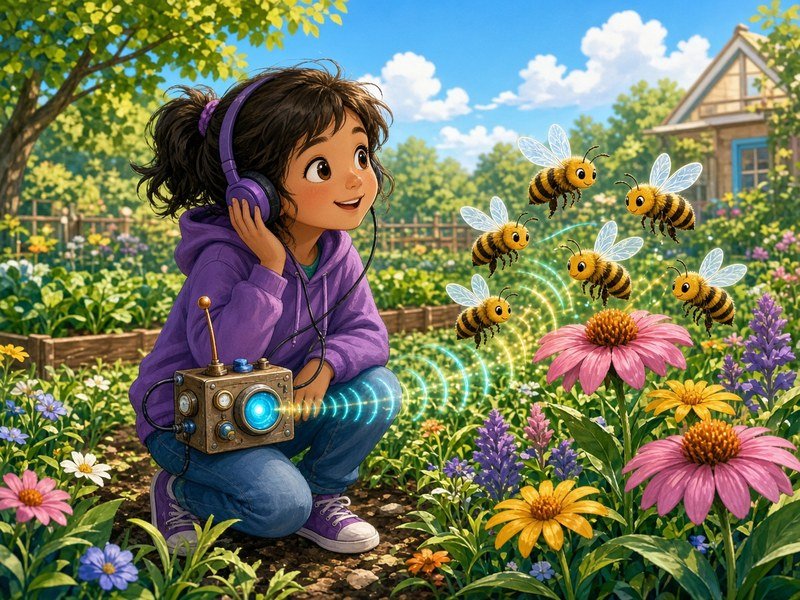
In the evening Rana told her father about the project. He took an old small recorder out of the cupboard, with a long microphone covered in foam and a pair of big purple headphones. He said: I used this recorder when I worked at the radio station. The microphone is very sensitive; it picks up faint sounds the ear usually does not notice. Rana put on the headphones and pointed the microphone at her father as he whispered, and she heard his voice clearly, as if he were speaking right into her ear. She cried: It is magic!
The next morning Rana put on her purple jacket, took the recorder, a small notebook and a pencil, and went with her mother to the neighborhood garden. The garden was full of flowers: yellow daisies, pink coneflowers with orange hearts, purple lavender and a small apple tree in the corner. Rana sat on the grass, switched on the recorder, closed her eyes and listened.
At first she heard sounds she knew: sparrows chirping in the tree, a car far away and a child laughing in the playground. Then she pointed the microphone at the flowers and heard a new sound: bzzzz, bzzzz. She opened her eyes and saw a small golden bee striped with black flying from flower to flower. Whenever the bee came close to the microphone the buzz grew louder, and whenever it moved away it grew softer. Rana wrote in her notebook: Sound one, the buzzing bee. Why does it buzz?
Rana asked her mother: Why does the bee make this sound? Is it singing? Her mother laughed and said: The buzz comes from its wings. A bee moves its wings very, very fast, more than two hundred times in a single second, and that fast movement shakes the air, so we hear the buzz. Rana's mouth fell open and she said: Two hundred times in one second? I can only clap two or three times!
Rana moved closer to the pink coneflower and sat quietly so as not to frighten the bee. She saw the bee push its head into the flower's orange heart and come out with two small yellow balls on its legs. Rana said: Mom, look! The bee is carrying two yellow bags! Her mother said: That is pollen, a soft yellow dust that flowers make. The bee gathers it as food for the young ones in the hive, and it also drinks the sweet nectar to make honey.
Then Rana noticed something important. The bee did not stay on one flower. It flew to a second flower, then a third, and each time some of the yellow dust fell onto the new flower. Rana asked: Is the pollen being wasted like that? Her mother said: No, Rana, this is the big secret. When pollen moves from one flower to another of the same kind, the flower can make seeds and fruit. This is called pollination.
Rana looked at the apple tree in the corner, which was covered in small white blossoms. She said: So the bees help the apple? Her mother said: Yes! Without bees and other insects, many flowers would never turn into apples, oranges, strawberries or almonds. We have these little insects to thank for a lot of the food we eat. Rana wrote in big letters in her notebook: The little bee makes the big apple! And next to it she drew a bee carrying an apple.
Next Rana pointed the microphone at an orange butterfly resting on the lavender. She waited a long time but heard almost nothing, only a very soft flutter when the butterfly flew away. She said: The butterfly is so quiet! Her mother said: That is because it moves its wings slowly, just a few times a second. But it helps the flowers too: it drinks nectar with its long tongue and carries some pollen on its legs. Rana wrote: Sound two, the butterfly's silence.
Then a big, plump bee covered in black and yellow fuzz came into the garden, and its buzz was deep like a little engine. Rana laughed and said: That is a grandma bee! Her mother said: That is a bumblebee. Watch what it does. The bumblebee landed on a flower and shook its body hard, and its sound changed and became higher. Her mother said: Some flowers hide their pollen inside, and the bumblebee shakes the flower with its buzzing until the dust falls out. Rana cried: It opens the flower with its voice!
At the end of the morning Rana recorded something she had not expected. She had placed the recorder near a small wooden hive looked after by the garden keeper, Uncle Fouad. When she listened to the recording, she heard a calm, steady hum like a song. Uncle Fouad explained: Inside the hive there are thousands of bees. Some of them fan their wings to cool the hive in the heat, like a fan. Beekeepers can tell from the sound of the hive whether the bees are calm or worried. Rana said: So the hive talks by humming!
Uncle Fouad warned her: Do not go too close to the hive, and do not wave your hands near the bees. A bee only stings when it feels in danger. If you stay calm, it will leave you alone and get on with its work. He told her that in many places bees had become fewer, because people cut down wildflowers and spray pesticides. Rana asked worriedly: What can we do? He said: We plant flowers, leave some wild corners and put out a small dish of water with pebbles in it so the bees can drink.
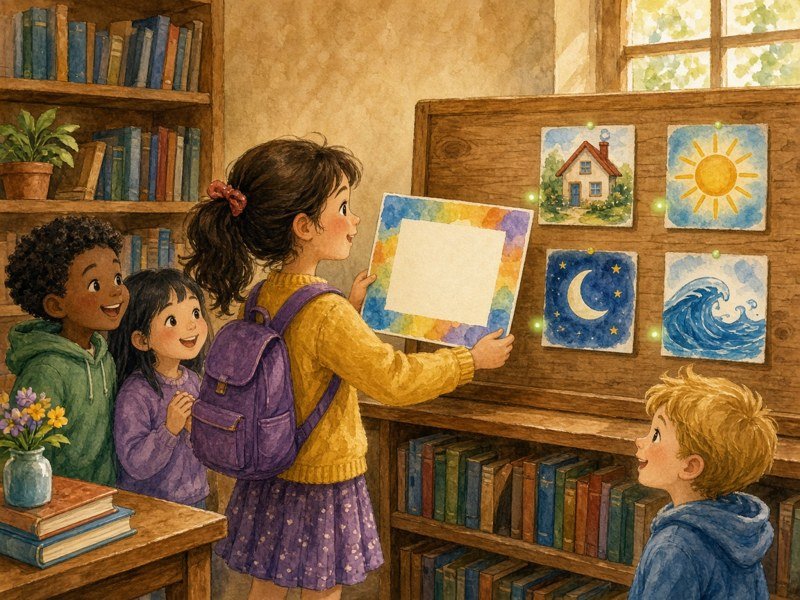
Rana went home excited and sat with her father listening to the recordings, cutting and arranging them on the computer. She painted a big poster titled The Journey of a Pollen Grain: the first flower, then the bee, then the second flower, then the fruit. On Thursday she stood in front of her class, put the headphones on her friend's ears and said: Close your eyes and listen. Then she played the buzzing, and everyone smiled.
Rana told the class everything she had learned: that a bee moves its wings two hundred times a second, that it carries pollen in two baskets on its legs, that the butterfly is quiet but helps too, that the bumblebee opens flowers with its voice, and that apples and strawberries need these insects. Then she said: And I have a suggestion: let us plant a small bee garden in the schoolyard. Ms. Suad clapped, and the principal agreed to the idea.
A month later, in a corner of the yard, there was a colorful bed of daisies, lavender and coneflowers, a dish of water with pebbles and a small sign painted by the children. Rana sat there at break time wearing her purple headphones, listening to the first bee that came to visit the bed. She said to her friend: Can you hear it? That is the sound of apples on their way.


💬 Comments (0)
Add a comment
No comments yet. Be the first to comment.