📖 Story
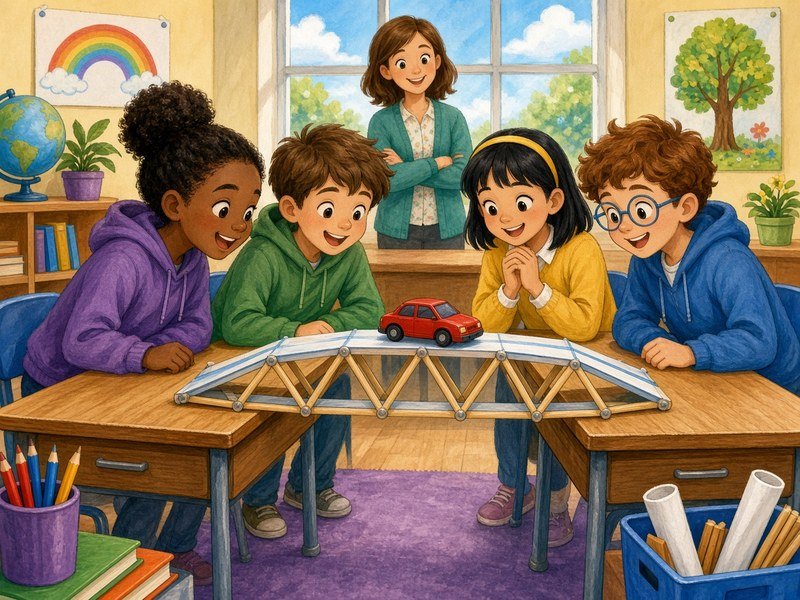
Mr. Walid walked into the sixth-grade class on Monday morning carrying a big cardboard box, which he set down on the table with a thump. He took out white paper, thin wooden popsicle sticks, tape, glue and a small red toy car. The students watched curiously, and he said with a smile: This month every team will become a small engineering company. The task: build a bridge between two tables forty centimeters apart that can carry this car, and then hold as much weight as possible.
Then he explained the rules as he wrote them on the board: The allowed materials are twenty sheets of paper, fifty sticks, one roll of tape and one tube of glue. The bridge may not touch the floor or be fixed to the tables. And the most important rule: every team keeps an engineers' notebook, recording every idea, every test and every mistake. In the end we will judge not only the strongest bridge but also the best notebook. Ali laughed and said: The notebook? What matters is that our bridge is the strongest!
A team of four was formed: Maryam, who loved drawing and design; Ali, who loved strength and speed and always wanted to win; Taym, the quiet one who loved numbers and calculations; and Jana, who asked the questions no one else thought of. They named their company the Qantara Company, after the old word for an arched bridge. At the first meeting Ali said excitedly: This is easy. We roll all the paper into tubes and stick them side by side, and we will have a thick, strong bridge. He started working before anyone had discussed the idea.
Jana said: Wait, Ali, shouldn't we test it first? But Ali had already begun rolling and taping the paper quickly, and the others followed because his enthusiasm was catching. By Thursday the bridge was ready: a flat board of taped paper tubes that looked very strong. They placed it between the tables and put the red car on it, and it held. Ali clapped and said: Did you see? The strongest bridge in the class! Then Mr. Walid began adding small weights to a basket hanging under the middle of the bridge.
One hundred grams, the bridge held. Two hundred grams, it held. Three hundred grams, and the bridge began to sag in the middle like a sad smile. Four hundred grams, and suddenly, snap! The bridge folded in the middle, the basket fell to the floor and the weights rolled under the desks. Some students laughed, Ali's face turned red and he sat down in silence. Another team's bridge held one thousand two hundred grams. Mr. Walid said: Never mind, Qantara Company. You have two more weeks. Now open your notebook and write: Why did it break?
At the next meeting Ali was angry and said: It was just bad luck. But Taym took out a piece of the broken bridge and said: No, look here. The bridge did not tear; it folded. The tubes on top were squeezed and crumpled, and the tubes underneath were stretched and the tape between them ripped. Jana said: So a bridge has two sides, one that gets squeezed and one that gets stretched? Taym said: That is what I read last night. They are called compression and tension, and every bridge in the world has to deal with them.
That evening Maryam searched the school library for books about bridges and saw pictures of old and modern iron bridges. She noticed something that appeared in almost every picture: triangles. Whole bridges made of connected iron triangles, electricity pylons made of triangles, even construction cranes. The next day she drew a square and a triangle made of sticks on the board and said: Try pressing on them. They pressed the square, and it leaned over into a slanted shape. They pressed the triangle, and it stayed exactly the same.
Mr. Walid, who had been listening from a distance, said: Well done, Maryam. The triangle is the only shape that cannot change its shape if its sides are fixed, and that is why engineers love it. Then Jana asked one of her unusual questions as always: What about arches? The old stone bridges did not have triangles, but they lasted hundreds of years. The teacher smiled and said: An excellent question. An arch turns the weight above it into compression that travels along the arch down to the ground, and stone is very strong in compression. Think about that.
The team met again, and this time nobody started building. Instead they sat and drew three designs in the notebook: a flat bridge with stronger tubes, a bridge made of triangles and an arched bridge. Taym said: We cannot build three full bridges; there are not enough materials. But we can build small twenty-centimeter models from the leftover paper and test them. Everyone agreed, even Ali, who said: All right. This time I want to know why we will win, not just assume we will.
They spent three days testing. They made the three small models, loaded them with pencils and erasers and then small books, and recorded the numbers precisely. The flat model held three hundred grams, the arched model held six hundred, and the triangle model held eight hundred grams. Maryam wrote in big letters in the notebook: Shape matters more than the amount of material! Then Jana said: What if we combine the two ideas? An arch underneath, with triangles linking it to the deck above?
They all looked at her. Then Maryam drew the new design: an arch of thin paper tubes, a flat deck for the car on top, and wooden sticks between them forming repeating triangles. Taym calculated the lengths so the arch would be perfectly symmetrical and made a table of the number of sticks they needed. Ali, with his strong hands, rolled very tight paper tubes and this time glued them carefully, not quickly. He learned to let the glue dry for a full hour before touching it.
Halfway through building, they discovered a new problem: the ends of the arch slid on the smooth tabletop when they pressed on the bridge, so the arch spread out and sank. They thought for a long time. Then Maryam said: Stone bridges had huge piers on both banks that stopped the arch from spreading. But we cannot fix it to the table. Then Taym said: We can tie the two ends of the arch with a strip of folded paper under the bridge, so it works like the string of a bow! They tried the idea on the model, and it never slid at all.
The day of the big test arrived. The students stood around the two tables, and the principal came to watch too. The Qantara Company set down its bridge. It was light and slender and looked much weaker than their first bridge. One student whispered: That will break straight away. But the team members were calm, because they had tested and calculated. The red car drove across the bridge, and then the teacher began adding weights: five hundred, one thousand, one thousand five hundred, two thousand... and the bridge held.
Two thousand five hundred grams, and the class began to clap. Three thousand, and the arch bent ever so slightly. Three thousand four hundred, then a faint sound was heard, one of the triangles in the middle folded, and finally the bridge collapsed. But the number had been recorded: three thousand four hundred grams, more than eight times their first bridge and the highest number in the class. Ali jumped up and hugged Taym, Jana and Maryam shouted with joy and the principal clapped for a long time.
When Mr. Walid announced the results, the Qantara Company won the prize for the strongest bridge and also the prize for the best engineers' notebook. The teacher read a page from their notebook to the class, written by Ali himself: Our first bridge was the worst bridge in the class, but it taught us more than anything else. We learned about compression and tension, the triangle, the arch and the tie. We learned to test before we build, to listen to Jana's questions, and that a team is smarter than the smartest person in it.
At the end of the lesson the teacher hung the remains of the first broken bridge next to the winning bridge on the classroom wall and wrote a small sign beneath them: This is where we started, and this is where we arrived. Whenever Ali walked past the wall, he looked at the broken bridge and smiled, because he now knew that a real engineer is not afraid of collapse, but asks: Why did it collapse? And then builds again, stronger and smarter.



💬 Comments (0)
Add a comment
No comments yet. Be the first to comment.