📖 Story
In a narrow alley of the old town, where the walls were stone and the doors were wood, there was a small shop that smelled of wet clay. On its wooden shelves stood long rows of jars, jugs, plates and cups, some blue, some brown and some decorated with patterns of flowers and birds. In the middle of the shop was a turning wooden wheel, and in front of it sat Grandpa Abdul Rahim, the old potter, in his gray turban, with hands that knew clay the way a mother knows her child's face.
His granddaughter Hala loved to spend her holidays in the shop. She was seven, and she sat on a little chair beside her grandfather, watching the lump of clay rise between his hands, spin and turn into a jar, as if it were growing like a flower. Grandpa would give her a small piece of clay, and she made birds, cats and little lopsided cups. He would laugh and say: Every great potter began with a lopsided cup.
On the highest shelf of the shop there was a jar different from all the others. It was big and dark green like olive leaves, with a delicate carving of two gazelles running around it. Grandpa never sold it. He told everyone who asked: This one is not for sale. My father, Hala's great-great-grandfather, made it more than seventy years ago, and it is the first jar on which he taught me to carve. Hala looked at it every day and wished she could touch the gazelles.
One morning Grandpa went to the market to buy wood for the kiln and said to Hala: Stay in the shop, and if anyone comes, tell them I will be back in half an hour. Hala sat alone and looked up at the green jar. She said to herself: I will touch the gazelles just once and then put it back. She fetched the little chair, stood on it, reached up and very carefully lifted the jar down.
The jar was heavier than she expected. Hala ran her finger over the gazelles and felt the fine lines her great-great-grandfather had carved seventy years before, and she smiled. But when she tried to put it back on the shelf, the little chair wobbled under her feet, the jar slipped from her hands and fell onto the stone floor. Crash! A loud sound filled the shop, then silence. Hala looked down and saw the green jar broken into six large pieces and many small ones.
Hala sat on the floor, her heart pounding and her hands trembling. She thought: What will I tell Grandpa? He will be very angry and sad, and he will never let me come to the shop again. Then an idea came to her: I will gather the pieces and hide them behind the clay sacks in the corner, and say I do not know what happened. Maybe he will think the neighbor's cat came in and knocked it down. Hala gathered the pieces quickly, wrapped them in a cloth and hid them in the dark corner.
Grandpa came back from the market carrying the wood and humming an old song. He put the wood down, then looked up at the high shelf and stopped singing. The shelf was empty. He asked quietly: Hala, where is the green jar? Hala felt as if there were a big stone in her throat, and she said in a weak voice: I do not know, Grandpa. Maybe... maybe the cat came in. Grandpa gave her a long look and said nothing. Then he sat down at his wheel and began to work in silence.
That day passed very heavily for Hala. She could not make a clay bird, she could not eat her lunch, and whenever she looked at her grandfather she saw him staring sadly at the empty shelf. That night she could not sleep. She thought about the gazelles, about her great-great-grandfather and about the lie that had become heavier than the jar itself. She said to herself: I did not only break the jar; I also broke Grandpa's trust.
In the morning Hala went to the shop before it opened and waited for her grandfather at the door. When he arrived, she took his hand and led him to the dark corner, took out the cloth, opened it in front of him and burst into tears, saying: I broke it, Grandpa. I took it down to touch the gazelles and it fell from my hands. It was not the cat. I lied because I was afraid. Forgive me, please forgive me.
Grandpa sat on the floor beside her and looked at the pieces for a long time. Then he raised his eyes to her and said: Hala, yesterday I was sad about the jar, but I was sadder that you did not tell the truth. Now you have given me back the most important thing. She asked in surprise: What is it? He said: Your honesty. A jar can be mended, but a lie that stays breaks something you cannot see. Then he wiped her tears and said: And you were brave to confess, because confessing is harder than breaking.
Hala said: But the jar is finished, Grandpa. Grandpa smiled and said: Who said so? Come, I will teach you something I have never taught anyone. He brought a small wooden box containing a tin of special glue for pottery, a shiny golden powder and a fine brush. He said: In a faraway land, people mend broken pottery with gold. They do not hide the cracks; they make them shine. They say that something broken and then mended has a story, and its story makes it more beautiful.
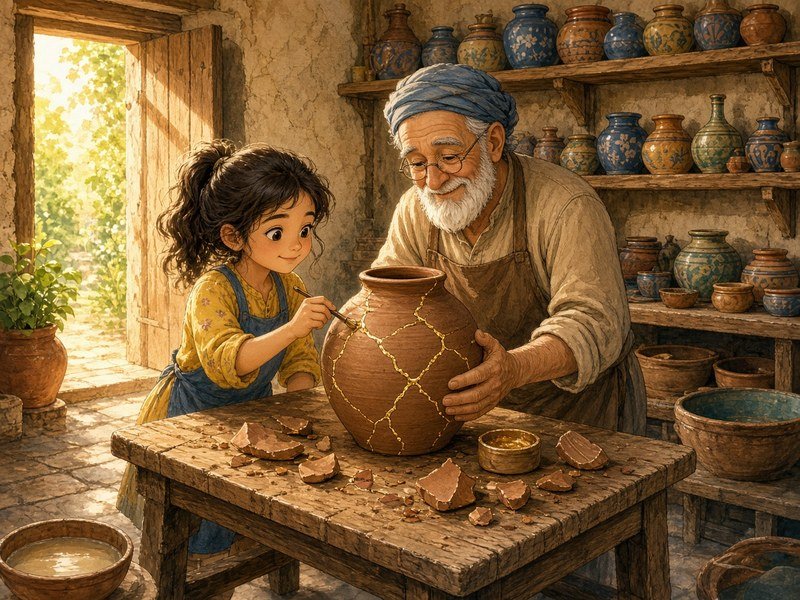
Grandpa and Hala began to work together. They cleaned every piece with a soft brush, then laid them out on the table like a big puzzle, looking for the piece that fit its neighbor. Hala found the small pieces with her sharp eyes, and Grandpa glued them with his skilled hands. The work was very slow and needed patience, because each piece had to dry before the next could be glued. Three days passed with them working every morning.
On the fourth day Grandpa mixed the golden powder with a little glue, handed Hala the fine brush and said: Now it is your turn. Paint a golden line over every crack. Hala held the brush in a trembling hand, then took a deep breath and began slowly painting the cracks. The golden lines spread over the green jar like little shining rivers, running between the gazelles, as if the gazelles were now racing along the banks of a river of gold.
When she had finished, Grandpa and Hala stood looking at the jar. It was not as it had been. It had many golden lines, and one very small piece near the rim had never been found. But it was beautiful in a new way. Grandpa said: Now this jar was made by three people: my father who shaped it, I who carved it for the first time, and you who mended it with gold. And it has a fourth story too: the story of honesty.
Grandpa put the jar back on the high shelf, but this time he secured it with a wooden stand. On a small card beside it he wrote: Not for sale. It has a story. Customers began asking about the golden lines, and Grandpa told them the story while Hala stood beside him, shy at first and then proud, because she knew the story had not ended with the breaking but had begun again with the truth.
From that day on, whenever Hala made a mistake, she remembered the green jar and went straight away to tell the truth, even when she was afraid. She discovered that fear becomes much smaller after confessing, and that the people who love us help us mend what we have broken. When Hala grew up, she became a potter like her grandfather, and in her shop she taught children that cracks are not the end of things, and that the real gold is honesty.



💬 Comments (0)
Add a comment
No comments yet. Be the first to comment.