📖 Story
On winter nights, when families gather around the fire in the wide desert tents and the stars glitter over the dunes like grains of salt on black cloth, the grandmothers tell an old tale whose beginning nobody knows. They say it is the tale of the palm that guides the caravans, and that whoever hears it must keep it and tell it to their children, because the tale itself is part of the promise. This is the tale as Grandmother Nawwar tells it to her grandchildren, in her calm voice that sounds like sand when the wind passes over it.
Long ago there was a boy named Suhail who worked with a great caravan carrying frankincense, salt and cloth from the coastal cities to the mountain towns. Suhail was neither a merchant nor a merchant's son. He was a poor orphan who watered the camels, gathered firewood and pitched the tents. But among the men of the caravan he was known for one thing: honesty. The merchants left their money bags with him when they went to the markets, because they knew he would not take a single coin.
The leader of the caravan was a wise old man named Sheikh Marzouq, who knew the desert roads as well as the lines on his palm. On one journey a great sandstorm blew for three days. It hid the road, buried the known wells and left the caravan lost in a sea of dunes that all looked alike. Little by little the water in the skins ran out. The men shared the last drops, and the camels groaned with thirst.
On the fourth day, when the storm calmed, Suhail found a small date stone in his pocket, left from the last date he had eaten. The merchants had begun to quarrel over the remaining water, each saying he deserved more than the others because he was richer or older. Suhail, however, took his small share of water and did not drink it. He dug a hole in the sand beside a large rock, placed the date stone in it and poured his whole share over it. Some of the men laughed at him and said: You water a date stone while we are dying of thirst?
Suhail said: My grandmother used to say that whoever plants in a day of hardship harvests in a day of relief. If we die here, perhaps this palm will grow one day and give water to those who come after us. Sheikh Marzouq heard him and was silent for a long time. Then he said to the men: The boy is wiser than all of you. From today we share the water fairly, drop by drop, with no difference between rich and poor or old and young. The merchants were ashamed. They sat down and shared what was left equally.
That night Suhail slept beside the rock. In his dream he saw an old woman whose robe was the color of sand and whose eyes were like two stars, standing by the hole where he had planted the date stone. She said to him: Suhail, you gave the last thing you owned to something you will never eat from. The earth does not forget those who give to it without reward. At dawn you will find what you are looking for. Then she vanished, leaving a scent in the air like palm blossom.
Suhail woke at dawn and found something wondrous. Where he had poured the water, a small green leaf had sprouted, and beneath it a damp patch of sand was spreading wider and wider. He called the men, and they came running and dug with their hands in the wet sand, and water gushed out from under the rock, fresh, clear and cold, as if it had been waiting all this time for someone to call it. The men drank, the camels drank, the water skins were filled, and everyone bowed down in thanks to God.
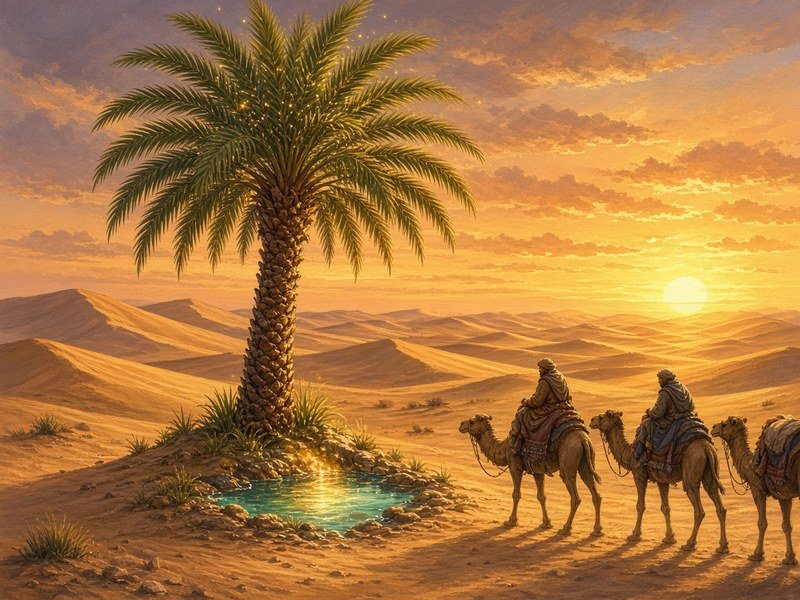
The caravan stayed at the spring for seven days, and the little plant grew unbelievably every day. On the seventh day it was a full palm tree, tall, with a trunk as straight as a spear and thick green fronds. At sunset, as the sun touched the horizon, the men saw something even more wondrous: the palm fronds began to glow with a soft golden light, as if they held the last rays of the sun and did not want to let them go. The light could be seen from very far away over the dunes.
Sheikh Marzouq said: This is no ordinary palm. It is the lighthouse of the desert. Then he gathered the men and said: This spring is not ours alone. It belongs to every lost and thirsty traveler. Let us pledge before God that no one will ever keep it for himself, that no traveler will be turned away from it and that its water will always be shared fairly. All the men swore to it, and they carved the pledge on the big rock beside the spring. From that day on, lost caravans saw the golden light at sunset and followed it until they reached the water.
Over the years people built mud houses around the spring and planted more palms, and it became a small green oasis in the heart of the sands. Suhail grew into a man and then became the sheikh of the oasis, and he stayed as he had always been: honest and fair, dividing the water among the orchards by the hour himself and welcoming every caravan as if it were his own family. The first palm stood in the middle of the oasis, taller than all the others, glowing every sunset as if telling the desert: Here is water, here is safety.
But the grandmothers say the tale was not all happy. Many years after Suhail died, a rich and greedy merchant came to the oasis. He bought much land and then said: Why should strangers drink from our oasis for free? I will build a wall around the spring, and whoever wants water will pay. Some people agreed with him, greedy for money, and they built the wall and put a gate with an iron lock on it. That evening at sunset the people waited for the golden light, but the palm stayed dark.
That same night a small caravan with women and children lost its way in the desert and did not see the light it was looking for. Days later a single man from it reached the oasis, exhausted and close to death, and asked for water for his family, whom he had left behind the dune. The guard at the wall said: Pay first. A little girl among Suhail's descendants, named Nawwar, heard what the guard said. She ran to her grandmother's house and said: Grandmother, the man is thirsty, the palm is dark and the pledge is broken!
The grandmother took her granddaughter by the hand, and they went to the big rock where the pledge was carved. They gathered the people, and the grandmother read the carving aloud: No one will keep it for himself, no traveler will be turned away from it and its water will be shared fairly. Then she said: We have put out our palm with our own hands. The people were ashamed and remembered the tale of Suhail they had heard as children. The men rose and tore down the wall stone by stone, and they carried water to the lost caravan until every one of them was saved.
At sunset that day all the people of the oasis stood looking at the first palm with fearful hearts. A long moment passed, and then the golden light began to creep through the fronds again, faint at first, then stronger and stronger, until it was more beautiful than ever. As for the greedy merchant, he left the oasis in shame and never returned. From that night on, the people of the oasis gathered at the rock every year, read the pledge in one voice and told the tale to the little ones.
Grandmother Nawwar always ends her tale with the same words as she gazes into the fire: My grandchildren, you may never find a glowing palm in your desert, for this is one of the tales of our ancestors. But you can be that palm yourselves. Whoever keeps their trust, shares fairly and gives water to the thirsty before asking about their money shines in the desert of people like Suhail's palm, and guides the lost to the road of water and safety.


💬 Comments (0)
Add a comment
No comments yet. Be the first to comment.