
📖 Story
Nour was seven years old. She loved drawing, singing, and stories, but she was afraid of one thing: math. To her, numbers were strange, cold shapes that never smiled or spoke, and whenever she saw a problem on the board, her head filled with fog.
On Sunday morning, Nour came into class and sat at her desk by the window, hoping there would be no math lesson. But Ms. Hala, the teacher, came in carrying a big colorful box, with a mysterious smile on her face. She put the box on the table and said, "Good morning, heroes!"
"Good morning, Ms. Hala!" the children replied. "Today we have very special guests," she said. "They're a little mischievous, and they love jumping and dancing. Do you want to know who they are?" "Yes!" shouted the children. She opened the box and said, "Today the numbers will jump out of their places!"
From the box she took big colorful cards, each with a number drawn in a funny way. Number one was tall and thin, wearing a red hat. Number two looked like a little duck swimming in a blue pond. Number three had big eyes and a wide grin. The children laughed a lot.
Number four looked like an upside-down chair with a kitten sitting on it. Number five wore sneakers and was running. Number six looked like a curled-up snail. Seven looked like a shepherd's staff. Eight was like a snowman with two circles. Nine was like a balloon on a string. And ten was number one standing beside his round friend, zero.
"These numbers got lost today and forgot their order!" said the teacher. "Who can help them stand in the right line?" She scattered the cards on the big table in the middle of the classroom. The children eagerly raised their hands, but Nour stayed still, watching the cards from far away.
Ms. Hala noticed that Nour was quiet. She came over and said gently, "Nour, I saw your beautiful drawings on the classroom wall. I think the numbers need an artist like you to help them. Will you try?" Nour hesitated a little, then stood up slowly and walked to the table.
Nour looked at the cards and no longer saw cold shapes; she saw funny characters. "Number one in the red hat should be at the front of the line, because he's the tallest and leads the others," she said, putting him first. Then she picked up the duck. "And this is Duck Two; she stands after him." The children laughed.
Nour went on: "Then laughing Three, then Four with the kitten, then sporty Five…" Each time she placed a number, she told a little funny story about it, and the children laughed and clapped. When she reached ten, she said, "And finally, One and his friend Zero stand together at the end of the line, because together they make ten!"
The whole class clapped. "Wonderful, Nour!" said the teacher. "You put the numbers in order from one to ten and told a story about each one!" Nour felt a lovely warmth in her heart, and for the first time there was no fog in her head. Then the teacher said, "Now, can you make two numbers dance together?"
"How do numbers dance?" asked Nour. "When two numbers meet and hold hands, we call it adding," said the teacher. "Come, take Duck Two and laughing Three." Nour took the two cards and placed them side by side, and the teacher put a plus sign, a little green cross, between them.
Then the teacher gave Nour five red plastic cherries. "Put two cherries next to the duck and three next to the laughing one." Nour did. "Now put them all together in one basket and count them." Nour counted: "One, two, three, four, five!"
"Five!" cried Nour. "Two and three make five!" She took the card of sporty Five and placed it after the equals sign. "Well done!" said the teacher. "That's the first addition problem you've solved today. Wasn't it easy?" Nour was amazed. "It was so easy! Like a game!"
"Now all the children will play," said the teacher. "I'll divide you into groups. Each group gets number cards and cherries and makes up its own addition problems." The children split into four groups. Nour was with her friends Sama and Rima and her friend Youssef.
Nour's group began to play. Youssef took four and one; they counted the cherries and got five. Sama took three and three and got six. Rima took five and four, and they counted slowly together and got nine. They laughed and clapped with every problem they solved.
Then Nour had a new idea. "Let's make a dance for each problem!" So they stood in a line, each holding a card. When two numbers met, they spun around together, and then the answer jumped out of its place. Ms. Hala laughed when she saw them. "That's the most beautiful number dance I've ever seen!"
The teacher asked each group to perform its dance in front of the class. Nour's group performed "Two and four make six": Youssef and Nour spun around, then Sama jumped out with the snail-shaped six, and everyone laughed. The other groups performed funny dances too.
At the end of the lesson, the teacher asked, "Who can tell me what we learned today?" Nour raised her hand first; it was the first time she had ever raised her hand in math. "We learned to put the numbers in order from one to ten, and that adding means putting things together and counting them."
"Excellent! And what else?" Nour thought and said, "And I learned that math isn't scary. It's a fun game if we learn it step by step." The teacher gave a big smile. "That's the most important thing we learned today."
When the bell rang, the children didn't want the lesson to end and asked to take the cards with them. "I'll give each of you small cards to play with at home," said the teacher. "I want each of you to make a new problem and draw it for us tomorrow."
Nour went home skipping with joy and ran to her mother. "Mama! The numbers danced in class today! I put them in order and solved addition problems!" Her mother was surprised, because she knew Nour was afraid of math. "Really? Show me!"
Nour sat with her mother at the kitchen table and took some grapes. "Look, Mama, three grapes and two grapes, how many is that?" She counted aloud: "Five!" Then she took apples. "And four apples and four apples?" She counted: "Eight!" Her mother was delighted and hugged her.
That evening, Nour sat in her room and drew a new problem with her colors: snail Six holding hands with laughing Three, and next to them balloon Nine flying in the sky. She drew flowers and stars around them and wrote underneath: "Six and three make nine, and numbers are my friends."
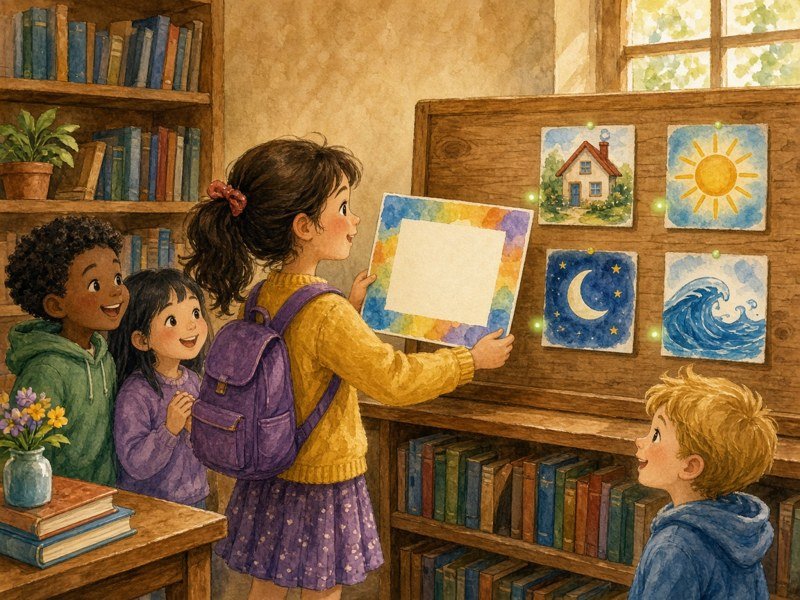
The next day, Ms. Hala hung Nour's drawing on the classroom wall next to the other children's drawings. From that day on, Nour looked forward to math class, talked about numbers as if they were friends, and helped classmates who found it difficult.
Nour learned that things that seem hard at first become easy and fun when we learn them step by step, use our imagination, play, and work with our friends. So we shouldn't fear new things, but try them with patience and enthusiasm, because every small step brings us closer to success.


💬 Comments (0)
Add a comment
No comments yet. Be the first to comment.