
📖 Story
Hossam was a fourth-grade student, clever and energetic. He loved science and sports and got good grades. But Hossam had one problem: he lost his temper quickly and didn't pay attention to his words. If someone was late, he said, "You're slow!" If someone made a mistake, he said, "How stupid!" And when he wanted something, he said, "Give me that!" without saying please.
Hossam didn't mean to hurt anyone; he just said words quickly without thinking. But he noticed that his classmates were slowly moving away from him. At recess they played together and didn't invite him, and in group projects no one wanted him on their team.
Hossam felt sad and angry at the same time. "Why don't they like me?" he asked himself. "I'm smart, and I'm the best football player in class!" He didn't understand that the problem wasn't his intelligence or his skill, but his words, which hurt people's hearts without his noticing.
One busy morning, Hossam woke up late, skipped breakfast, and ran to school angry. On the way he shouted at his little brother, "Hurry up! We'll be late because of you!" When he reached the school gate, he pushed it hard and didn't answer the guard, Uncle Saleh, who said, "Good morning, Hossam."
In the hallway, Hossam was carrying a big pile of books and notebooks, with his heavy bag on his back, walking fast. Suddenly he tripped over the edge of the carpet. All his books fell to the floor, papers scattered everywhere, his pencil case opened, and his pencils rolled under the desks.
Hossam stood there angrily and almost shouted, "What a terrible day!" But then he saw his classmate Hanaa coming toward him with a calm smile. Hanaa was one of the students Hossam had sometimes spoken harshly to; just last week he had told her that her drawing was "ugly." He expected her to laugh at him or walk past without helping.
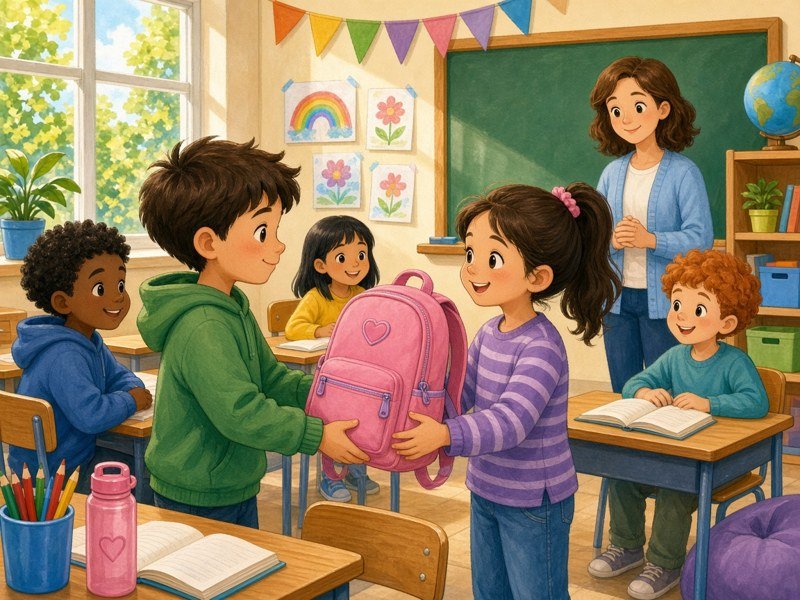
But Hanaa bent down and began gathering the books and papers. "It's all right, Hossam," she said kindly. "This happens to all of us. Let me help you." She collected the pencils from under the desks, arranged the papers, and handed him everything neatly. Then she smiled. "Have a lovely morning. I hope your day gets better."
Hossam stood there amazed and didn't know what to say. He felt something strange in his chest, something warm and embarrassing at the same time. Then, for the first time in a long while, he said quietly, "Thank you, Hanaa." Hanaa smiled. "You're welcome, Hossam," and went to her class.
Hossam went into class and sat down, but he couldn't forget what had happened. "Why did Hanaa help me when I'd been mean to her?" he wondered. He remembered how he felt when she said "It's all right," and how his anger had suddenly disappeared. "One small kind word changed my whole day," he told himself.
Just then, Mr. Adel came in. Today's writing lesson was called "The Power of Words." "Children," he said, "words are like seeds. If we plant kind words, friendship and love grow. If we plant harsh words, thorns grow that hurt hearts. Today we'll do a small experiment."
Mr. Adel took out a smooth white sheet of paper and asked Hossam to come to the board. "Crumple this paper hard, as if you were angry," he said. Hossam crumpled it into a small ball. "Now open it and try to make it smooth again, and say to it: Sorry."
Hossam opened the paper, tried to smooth it with his hands, and said, "Sorry." But the paper stayed full of wrinkles and lines. "That's what harsh words do to hearts," said the teacher. "We can apologize, and apologizing is very important, but some marks remain. That's why it's better to think before we speak."
Hossam looked at the wrinkled paper for a long time and remembered all the harsh words he had said to his classmates. He felt ashamed and went back to his seat in silence. Then the teacher said, "But there's good news. Kind words have magic power too. There are small words that open closed doors: please, thank you, sorry, good morning."
The teacher challenged the students for one day: each of them should use these four words as many times as possible and notice what happened. Hossam secretly decided to take the challenge seriously, to see whether words could really change anything.
At recess, Hossam went to the canteen. Usually he said to the seller, "Give me a juice!" But this time he said, "Good morning, Uncle. An orange juice, please." The seller smiled widely. "Good morning, son! Here you are, and here's a biscuit as a gift because you're so polite." Hossam was surprised. "Thank you very much!"
Then Hossam saw his classmates playing football and went over. Usually he said, "I'm playing, and I'm the captain!" But this time he asked, "May I play with you, please?" The boys looked at him in surprise, then Salim said, "Of course, Hossam, come on!" Hossam played with them, and when a teammate made a bad pass, he said, "That's okay, good try!"
After recess, Hossam went to Hanaa and stood before her nervously. "Hanaa, I'm sorry I said your drawing was ugly last week. It wasn't true, and it wasn't kind. Your drawing was actually beautiful." Hanaa smiled. "Thank you, Hossam. That means a lot to me. I forgive you."
By the end of the day, Hossam noticed how the faces around him had changed. His classmates smiled at him, talked with him, and asked his opinion. When the teacher announced a new group project, three classmates raised their hands and said, "We want Hossam on our team!" Hossam felt a joy he hadn't felt in a long time.
On the way home, Hossam passed the gate and saw Uncle Saleh. "Goodbye, Uncle Saleh, and thank you for guarding us every day," he said. Uncle Saleh was surprised and smiled broadly. "May God keep you, Hossam. You're a good boy." Hossam walked on with a heart as light as a feather.
At home, Hossam saw his little brother and remembered how he had shouted at him that morning. He went over and said, "I'm sorry I shouted at you today. It wasn't your fault we were late; it was mine, because I woke up late." His little brother hugged him. "It's okay, Hossam, I love you." Their mother smiled from across the room.
In the evening, Hossam sat with his father and told him about his day, about the crumpled paper and the four magic words. "I'm proud of you, Hossam," said his father. "It isn't easy to change a habit, but you did it in one day. The important thing is to keep going." "I will, Dad," said Hossam. "I loved how I felt today."
From that day on, whenever he got angry, Hossam paused before speaking, took a deep breath, and chose his words carefully. He no longer said hurtful things to others; instead he encouraged them, thanked them, and apologized when he was wrong. He became one of the best-loved students in class, and Hanaa became one of his dearest friends.
Hossam kept the crumpled paper from Mr. Adel's lesson in his notebook, so that whenever he looked at it he would remember that words leave marks. Under it he wrote in his own handwriting: "Before I speak, I ask myself: Is my word kind? Is it true? Is it helpful?"
Hossam understood that a kind word is a small key that opens big doors, and that words like please, thank you, and sorry bring hearts closer and make days more beautiful. A gentle word costs us nothing, but it plants love in others' hearts and comes back to us as joy, friendship, and respect.


💬 Comments (0)
Add a comment
No comments yet. Be the first to comment.