📖 Story
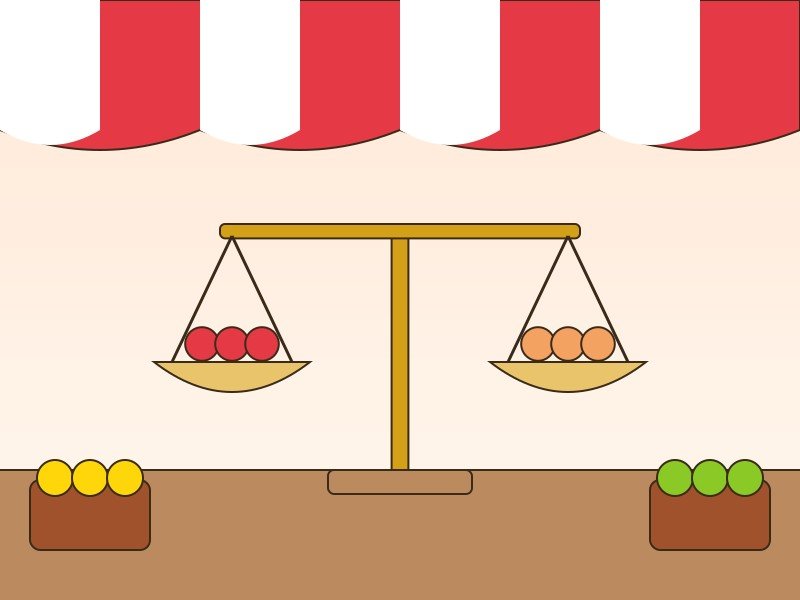
Hamza was eight years old, and he loved Saturdays very much, because that was the day he went with his grandfather to the fruit shop in the market. The shop was small but full of colours: red apples, oranges, yellow bananas and green grapes. In the middle of the shop stood an old, shiny scale that Hamza loved.
A woman came and said, "I'd like a kilo of apples, please." Hamza took the apples and put them on the pan, and the scale showed a little less than a kilo. Hamza thought to himself, "That's close; no one will notice." He reached out to put the apples in the bag. But his grandfather gently held his hand and added a small apple, until the weight was a kilo and a little more. Then he handed the bag to the woman with a smile.
When the woman had gone, his grandfather said, "Hamza, did you know that Allah sent a whole prophet to teach people not to cheat on the scale?" Hamza said in surprise, "A prophet just for the scale?" His grandfather laughed, sat down on his wooden chair and said, "Come, let me tell you the story of Allah's prophet Shu'ayb, peace be upon him."
His grandfather said, "There was a people who lived in a land called Madyan, near the caravan route between Syria and the Hijaz. They were traders who bought and sold a great deal, and they had many trees. Allah gave them goodness and provision. But they worshipped others besides Allah, and they had a very bad habit: they cheated in their trade."
Hamza said, "How did they cheat?" His grandfather said, "When they bought from people, they took their full due, and when they sold to people, they gave short measure and short weight. That means they gave you less than you'd paid for. Allah says about such people: 'Woe to those who give less than due, who, when they take a measure from people, take in full, but if they give by measure or by weight to them, they cause loss' [al-Mutaffifin 83:1-3]."
Hamza's face went a little red as he remembered the apples. Then he said, "What did Shu'ayb say to them?" His grandfather said, "Allah sent them a man from among them, Shu'ayb, peace be upon him. He said to them: 'O my people, worship Allah; you have no god other than Him. And do not decrease from the measure and the scale. Indeed, I see you in prosperity, but indeed, I fear for you the punishment of an all-encompassing Day' [Hud 11:84]."
Then his grandfather said, "Look, Hamza: he began with the most important thing, worshipping Allah alone. Then he forbade them from cheating. And he told them: I see you in prosperity, meaning you have wealth and provision, so why cheat? You don't need to."
He went on, "He also said to them: 'And O my people, give full measure and weight in justice and do not deprive the people of their due and do not commit abuse on the earth, spreading corruption' [Hud 11:85]. 'In justice' means fairly. 'Do not deprive the people of their due' means don't cut back people's rights, and don't belittle the value of their things."
Hamza asked, "What does 'do not deprive the people of their due' mean?" His grandfather said, "For example, if a man comes to sell you good oranges, don't tell him his oranges are bad so that you can buy them cheaply. That's depriving him of his due. We must be honest when we buy and sell."
Then his grandfather said, "Shu'ayb told them something beautiful: 'What remains from Allah is best for you, if you would be believers' [Hud 11:86]. That means the small, lawful profit that remains for you after you've given people their rights has blessing from Allah in it, and it's better for you than lots of money taken by cheating."
Hamza said, "And did they listen to him?" His grandfather said, "No, sadly. They mocked him and said: 'O Shu'ayb, does your prayer command you that we should leave what our fathers worship, or not do with our wealth what we please?' [Hud 11:87]. That means: is it your prayer that tells us what to do with our money? We're free!"
Hamza said, "But cheating isn't freedom; it's wronging people!" His grandfather said admiringly, "Well said, Hamza! That's exactly right. And Shu'ayb answered them politely and calmly: 'I do not intend to differ from you in that which I have forbidden you; I only intend reform as much as I am able. And my success is not but through Allah. Upon Him I have relied, and to Him I return' [Hud 11:88]."
Then his grandfather explained, "That means: I don't tell you to do something and then do the opposite myself. I'm the first to act on what I say. And all I want is to set your affairs right. Shu'ayb spoke eloquently and argued well; he talked to his people kindly and reminded them of Allah's blessings, saying to them: 'And remember when you were few and He increased you' [al-A'raf 7:86]."
Hamza said, "And what happened after that?" His grandfather said, "Most of them kept on being stubborn. They even threatened to drive Shu'ayb and the believers out of their town. Allah says: 'We will surely evict you, O Shu'ayb, and those who have believed with you from our city, or you must return to our religion' [al-A'raf 7:88]. But Shu'ayb and the believers stayed firm in their faith and prayed to Allah: 'Our Lord, decide between us and our people in truth, and You are the best of those who give decision' [al-A'raf 7:89]."
Then his grandfather said quietly, "So Allah's command came. He punished those who insisted on wrongdoing and disbelief, and none of them remained, and He saved Shu'ayb and the believers. Allah says: 'And when Our command came, We saved Shu'ayb and those who believed with him, by mercy from Us' [Hud 11:94]. Cheating and injustice don't last; justice remains."
Then his grandfather said, "Our Prophet Muhammad ﷺ taught us the same lesson. One day in the market he passed by a heap of food. He put his hand into it and found his fingers wet. He said to its owner: What is this? The man said: Rain fell on it, O Messenger of Allah. He ﷺ said: Why didn't you put it on top of the food so that people could see it? Whoever cheats is not of me. This is narrated by Muslim."
Hamza said, "So the seller hid the wet food under the dry food?" His grandfather said, "Yes, and that is cheating. An honest Muslim shows the defects in his goods and doesn't hide them. That's why you see me put the soft fruit to one side in our shop, sell it for less, and tell people it's soft."
Then his grandfather said, "And the scale isn't only in shops, Hamza. Allah says: 'And the heaven He raised and imposed the balance, that you not transgress within the balance. And establish weight in justice and do not make deficient the balance' [ar-Rahman 55:7-9]. Allah created the whole universe with a precise balance, and He commanded us to be fair in everything: in trade, in what we say, in judging between our brothers and sisters, and even in sharing out sweets!" Hamza laughed and said, "Even sweets?" His grandfather said, "Yes, even sweets."
Then his grandfather said, "And the Prophet ﷺ said: May Allah have mercy on a man who is easygoing when he sells, when he buys, and when he asks for what he is owed. This is narrated by al-Bukhari. That means being kind and generous in buying and selling, and when asking people for what you're owed." Hamza said, "I want Allah to have mercy on me. I'll be easygoing."
Hamza looked at the scale, then said, "Grandpa, today I nearly gave a little short weight. I thought the difference was small and no one would notice." His grandfather hugged him and said, "Allah notices, Hamza; Allah sees everything. And a small difference becomes big when it's repeated with everyone. But you're honest, because you told me, and that's beautiful."
Just then a man came and asked for a kilo of oranges. Hamza weighed the oranges carefully, looked closely at the scale, and then added one small extra orange. He said to the man with a smile, "Here you are, uncle: a full kilo and a little extra!" The man laughed and said, "May Allah bless you, my son." Hamza looked at his grandfather, who winked at him and said, "What remains from Allah is best for you."



💬 Comments (0)
Add a comment
No comments yet. Be the first to comment.