
📖 Story
In a quiet neighborhood decorated with jasmine trees, where the smell of fresh bread drifted out every morning, there lived a boy named Anas, eight years old. Anas loved football more than anything. He played it in the morning and in the afternoon and dreamed of becoming a famous player whose name crowds would cheer. He had a close friend named Ziad, who lived in the house next door, and they played together every day in their little street.
At the end of the street lived Uncle Mansour, an elderly, kind-hearted man with a white mustache and a wooden cane. He loved flowers dearly, and his balcony was full of colorful pots: red roses, white carnations, and green basil. But his most precious pot was a blue one decorated with white patterns, in which a small jasmine bush grew.
Uncle Mansour would tell the children about this pot: "My late wife made it with her own hands forty years ago, and she planted this jasmine in it the day my son was born. Whenever I smell it, I remember our beautiful days." He watered it every morning with a small copper jug and gently wiped its leaves as if he were talking to it.
One sunny afternoon, Anas and Ziad were playing football near Uncle Mansour's house. "Come on, Anas," said Ziad, "show me your powerful kick!" Anas stepped back, then ran and kicked the ball with all his strength. The ball flew high, very high, then curved toward the balcony. In a single moment, there was a sound: CRASH!
The two boys froze. They saw the blue pot broken on the ground in little pieces, the soil scattered, and the jasmine bush lying on its side. "The blue pot!" whispered Ziad. They heard a door open inside the house, and Uncle Mansour's slow footsteps and the tap of his cane on the floor.
"Run!" said Anas in a trembling voice. The two boys ran as fast as they could and hid behind a car far away. From there, Anas saw Uncle Mansour come out onto the balcony, bend down slowly over the broken pieces, and lift the jasmine bush with shaking hands. Uncle Mansour didn't shout and didn't get angry. He just sat down on his chair and looked at the blue pieces for a long time, then wiped his eyes with his handkerchief.
Anas went home and told no one anything. At dinner, his mother had cooked maqluba, which he loved, but he ate only two bites. "What's wrong, Anas?" she asked. "Are you sick?" "No, Mama, I'm just not hungry," he said. He looked at his plate and felt as if there were a heavy stone in his stomach.
That night he couldn't sleep. Whenever he closed his eyes, he saw Uncle Mansour wiping away his tears. Whenever he heard the wind, he thought it was the sound of the pot breaking again. He tossed and turned in bed and told himself, "Nobody saw me. Nobody will know." But a small voice in his heart said, "But you know, Anas."
In the morning he went to school tired. In class, Ms. Salma was telling them about honesty. She said, "A lie is like a pebble in your shoe. No one else may see it, but it hurts you with every step. Running away from a mistake doesn't erase it; it makes it heavier." Anas felt as if the teacher were speaking to him alone, and his face turned red.
At break, he sat with Ziad under the mulberry tree and said, "Ziad, I can't forget the pot." "Me neither," said Ziad anxiously. "But if we tell him, he'll be angry, and he might tell our parents." Anas thought for a moment, then said, "Maybe he'll be angry. But I'd rather he be angry with me for being honest than keep feeling this stone in my heart."
On the way home from school, Anas passed Uncle Mansour's house and saw him sitting on the balcony, watering his flowers with his copper jug, but he wasn't humming as he usually did. Anas saw the empty spot where the blue pot used to be, and the jasmine bush sitting in an old milk can, its leaves drooping sadly. Anas walked faster and looked at the ground, as if he were afraid Uncle Mansour would read the truth in his eyes. When he got home, he threw his bag on the bed and sat in silence, his ball in the corner of the room untouched.
A little later, Anas went to his father and said in a low voice, "Baba, I want to tell you something." He told him everything that had happened, with tears running down his cheeks. His father listened calmly until he finished, then put a hand on his shoulder and said, "Anas, breaking the pot was an accident. Running away was the bigger mistake. But what you're doing now, admitting it, that is real courage." Then he asked, "And what do you want to do?"
"I want to apologize to Uncle Mansour and fix what I broke," said Anas. "That's a lovely idea," said his father. "But his wife made that pot with her own hands, and we won't find another one like it in the market. Think: how do you fix something that can't be bought?" Anas thought for a long time, then his face lit up. "I know! I'll gather the pieces and we'll glue them back together! And I'll use my pocket money to buy a new pot for the jasmine bush so it doesn't wilt."
That evening, Anas and Ziad knocked on Uncle Mansour's door, their hearts pounding, with Anas's father standing behind them. When Uncle Mansour opened the door, Anas spoke quickly, before his voice could fail him: "Uncle Mansour, I'm the one who broke the blue pot with my ball. I ran away because I was scared. I'm very, very sorry." And Ziad said, "I was with him, and I ran away too. We're both sorry."
Uncle Mansour was silent for a long moment while Anas looked at the ground. Then he bent down, lifted Anas's chin with his finger, and said in a warm voice, "My son, I was sad about the pot, but I was sadder because I thought the children of our neighborhood didn't care. Now you've come and told the truth. That means more to me than any pot."
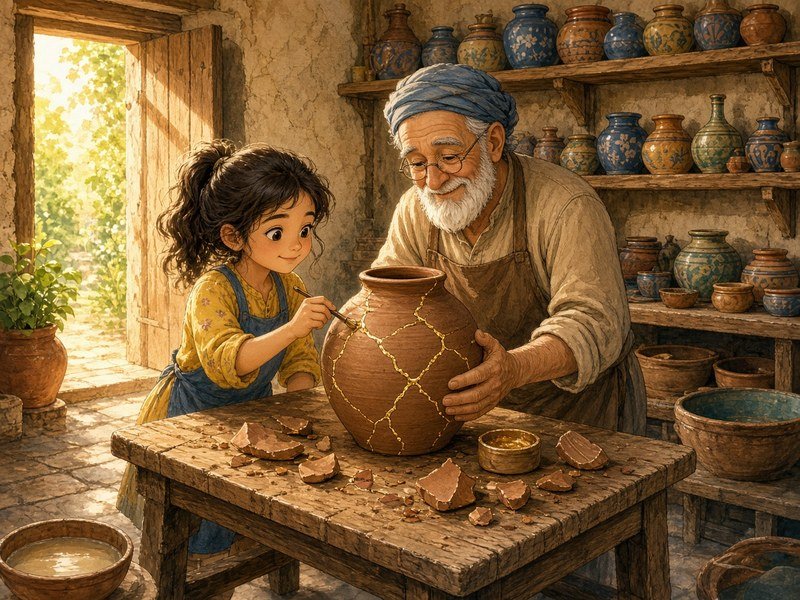
"Uncle," said Anas, "may I help you mend it?" Uncle Mansour smiled and brought a box in which he had put all the blue pieces. "I meant to, but my hands shake," he said. In the days that followed, Anas and Ziad sat with Uncle Mansour on the balcony, carefully gluing the pieces, one after another, while he told them about his wife and his young days. Anas bought a new pot with his pocket money, and they planted the jasmine in it, and it began to bloom again.
As they worked, Uncle Mansour taught them many things: how to hold a tiny piece with tweezers, how to put on just one drop of glue so it wouldn't run, and how to wait patiently for it to dry. Sometimes Ziad was in a hurry, and Uncle Mansour would laugh and say, "Ziad, broken things need patient hands, just like hearts do."
When the blue pot was finished, it had thin lines where it had broken. "It isn't the way it was," said Anas sadly. "No," said Uncle Mansour, "it's more beautiful, because every line in it tells the story of two honest boys." He set it on a high shelf and wrote beneath it in beautiful handwriting: "The Pot of Honesty."
From that day on, Anas and Ziad played football in the big open square, far from the balconies, and every Friday they visited Uncle Mansour to water the flowers with him and listen to his stories. And every night Anas slept peacefully, with no stone in his heart.
Anas learned that anyone can make a mistake, but running away from it makes it heavier, and that honesty takes courage, but it brings peace to the heart and wins people's love. Whoever admits a mistake, apologizes, and tries to repair the harm becomes stronger and more beautiful, just like the blue flowerpot.



💬 Comments (0)
Add a comment
No comments yet. Be the first to comment.